
The Curious Incident of the Dog in the Night-Time
Posted: September 30, 2014 Filed under: Broadway, Drama, Play | Tags: alexsharp, broadway, christopherboone, curiousincident, markhaddon, review, thecuriousincidentofthedoginthenighttime, westend Leave a comment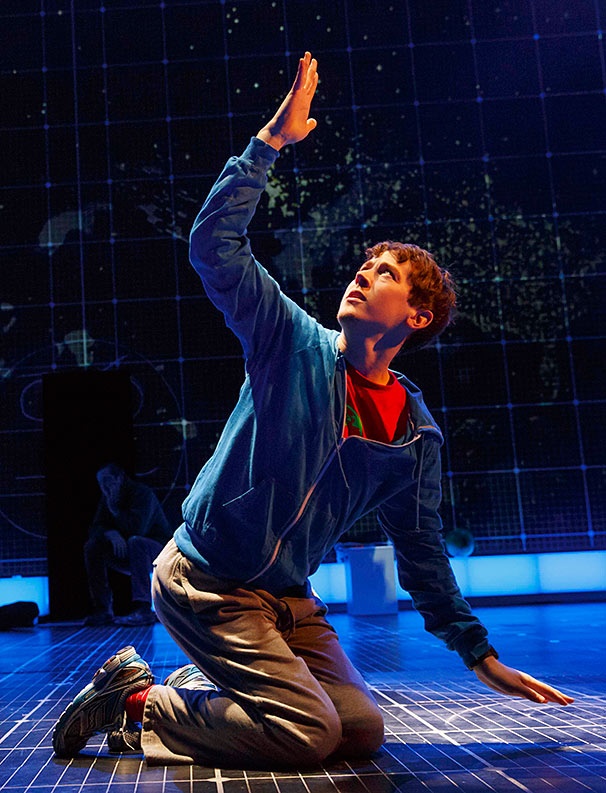
I liked this play a lot. It wasn’t necessarily life-changing, and I wouldn’t necessarily insist that you need to pay full price for a ticket, but I would say that if you have the opportunity to go, take advantage of it for a unique theatrical experience.
For the people out there who have not read the book (or the people who have and simply forgot everything about it like me), The Curious Incident of the Dog in the Night-Time came out in 2003, written by British novelist Mark Haddon. It’s about a 15-year-old boy named Christopher Boone. Christopher is extremely gifted in math, logic, and all things science, but he struggles socially. He doesn’t like when people touch him. He is easily overstimulated and screams until he is able to calm down. He has a complicated relationship with his dad and maybe an even more difficult relationship with his mother before she passed away two years earlier. The story begins with a neighbor’s dog being murdered. And à la John Coffey in The Green Mile, Christopher is found cradling the dead dog and is immediately accused. He makes it his mission to find out who did it and starts detective work even though he doesn’t like talking to strangers. But as he starts to dig, other mysteries begin to unravel as well, forever changing his life as he knows it.
The production (a transfer from the National Theatre in London) is very innovative and smart. It’s well-directed, and the design is arguably the best part. The creative team has done an excellent job of making the audience feel – or at the very least, understand – how Christopher feels day-to-day. In one scene, he explains that he “sees everything.” You know how Raymond counts the toothpicks in a split second? Like that, Christopher registers every single thing around him. Therefore, if he’s in a crowded place like a train station, it’s an unreal amount of stimulation that overwhelms and cripples him until he is able to find a rhythm to the madness. This then guides him back to his own personal equilibrium. So, through a slick scenic design, charged music, flashing lights, and incredibly well-used projections, the stage transforms into what’s going on in his brain during these moments. It can be very unnerving at times (in the best way possible). With such an effective design and moving choreography, the creators have set up a great storytelling convention for us to go directly into this kid’s mind. Now that I think about it, even in the calmer sections, the design is still how Christopher sees the world – like a grid, finding whatever sense he can in his surroundings. For example, he builds a train set throughout Act 1, literally taking the different pieces out of the walls around him. Everything is compartmentalized, organized, and clean…until it’s not, and he panics. Christopher is wonderfully played by Alex Sharp, a 25-year-old recent graduate of Juilliard (and by recent, I mean this past May). You’re looking at a future Tony nominee, folks.
Now this isn’t exactly a heads-up per se, but I feel like I should note again that this production came over from the West End, and you can definitely tell. This is British theatre at its core. It’s hard to explain what I mean by that. Basically, the style is different – the way of storytelling, the pacing, etc. Quite often, it can be tricky for plays to make the jump across the pond for these very reasons. Sometimes, American audiences have a difficult time adjusting to the style shift. I’m very curious to see what the critics will think. I personally like that it’s structurally different and that the storytelling makes you work, although the pacing was often a problem. I was bored at times, and it’s a little long. Granted, I saw it in the middle of previews, so this may change (they even had to hold for a few minutes during Act 2 due to technical difficulties. Ohhh previews.).
So my bottom line? It’s a striking design and a very, very technical show, but what’s lovely – and crucial – is that amidst all the flash and spectacle, Curious doesn’t lose its heart.
The Curious Incident of the Dog in the Night-Time
Written by Simon Stephens, Based on the novel by Mark Haddon, Directed by Marianne Elliott
Barrymore Theatre, Open-ended
Photo Credit: Joan Marcus
Pictured: Alex Sharp
King Lear
Posted: August 14, 2014 Filed under: Drama, Off-Broadway, Play, Shakespeare | Tags: blowwindsandcrackyourcheeks, delacorte, johnlithgow, kinglear, publictheatre, review, shakespeare, shakespeareinthepark Leave a comment
What a beautiful night in the park I had last week. Thanks to a dear friend who hooked me up with tickets, I took my dad to see his very first Shakespeare in the Park! I tried to see Much Ado About Nothing last month, and the performance was unfortunately canceled due to those insane hurricane rains. Thankfully, we had better luck with King Lear, and the weather could not have been more ideal for an evening of outdoor theatre.
King Lear is a striking production (click here for a montage), although I wasn’t fully engaged the whole time. The reviews have been very mixed, and I can see where they’re coming from. I’m giving the show a solid “good” (I should note – my dad thought it was excellent). While the play wavered and lost my rapt attention in spots, for the most part, I was hooked in with the action, which drove ever forward during the three-hour tragedy. I felt Act II especially found its stride.
The cast is led by the incomparable John Lithgow whose Lear is adamant and stubborn and sad. Witnessing him fall into madness leaves us full of pity despite the arrogance that blinds him in the first scene of the play (Lithgow kept a wonderful blog throughout the rehearsal process for the New York Times. I encourage you to check it out if you’re interested in reading more about the behind-the-scenes work). The Fool, played excellently by Stephen Boyer, brings humor and wit to all of his scenes. Another acting highlight, as always, is Jay O. Sanders as Kent. Sanders is a constant favorite of mine in the park. I have had the opportunity to see him in Hamlet, Twelfth Night, and A Midsummer Night’s Dream. His performances are always vibrant, full, and clear in his choices, no matter the role size. Sheffer Stevens as Edmund is also strong; I very much enjoyed his work in Act I as he connives against Gloucester and Edgar.
A few of the performances fell flat for me, perhaps only compared to the more brazen Lithgow. Annette Bening and Jessica Hecht (as Goneril and Regan, respectively) – and I’m a big fan of both – didn’t stir me as much as I’d hoped. Whether this was a directing or acting choice I don’t know, but their cold and calculating deliveries left me wanting more. What’s bubbling beneath the surface? I wanted more real connection between the characters, no matter the quality of the relationship. Perhaps their distant nature further adds to what pushes Lear over the edge, but I craved something deeper. For example, I found the relationship that developed between Lear and his fool to be very touching. It is clear that despite their jokes, they deeply care for each other, and as Lear veers toward madness, you can see him reaching out to his fool in a desperate hope to stay grounded.
There is an ominous percussion underlying most of the action, which sets the looming mood in addition to creating the booming thunder of that infamous storm. One of the best aspects of the play is how extremely clear the language is. We heard every word thanks to excellent diction and a clear understanding from all of the actors as to what they were saying. So while occasionally stagnant, it’s certainly a worthy production worthy of your time.
King Lear
Written by William Shakespeare, Directed by Daniel Sullivan
Delacorte Theatre, Closing August 17th
Photo Credit: Joan Marcus
Pictured: Steven Boyer, Jay O. Sanders, John Lithgow, and Chukwudi Iwuji
Of Mice and Men
Posted: July 18, 2014 Filed under: Broadway, Drama, Play, Revival | Tags: alexmorf, broadway, chrisodowd, george, jamesfranco, johnsteinbeck, lennie, ofmiceandmen, review 2 Comments
Of Mice and Men is a visually beautiful production. From the opening moments of the sun shining through what appears to be an iron wall split by the horizon, the set is rustic and full of striking metals. Here’s the thing though: the play itself didn’t leave me feeling like I’d been punched in the gut. I talk about this expectation a lot actually, and I suppose it’s odd to say I’m disappointed when I don’t get to feel like that. But that’s what theatre is for sometimes – to feel like your stomach has been turned upside down or your mind has been messed with or your heartstrings tugged. It’s one thing to be emotionally manipulated à la Spielberg’s “ET” with camera close-ups and music swelling at just the right moment, but another thing to be emotionally torn apart by the story alone. It’s why John Steinbeck’s novel is so iconic – the tragedy of Lennie’s and George’s story stays with us, leaving us feeling anywhere from distraught and angry to hollow and sympathetic. This production landed more in neutral territory.
I am going to condense the spoilers as much as I can due to the fact that some people have yet to see the play or read the book or see the movie (seriously though, I would get on that). My roomie had no idea what was going to happen, which made for a fun intermission of predictions. Needless to say, sh*t goes down, and you can tell as early as the looming scenes of Act 1 that things will not be ending super well for these characters.
Chris O’Dowd gives a beautiful, innocent, nuanced performance as Lennie. He’s endearing, touching, and an incredibly sympathetic character. I did not connect with James Franco’s George as much. He has some nice moments, but I think his work may be too subtle for the theatre. I did see him trying, but he lacked life on stage. He’s playing for the camera, and in a big house, his acting gets lost. I imagine audience members in the first few rows have an entirely different experience of his work. I did enjoy the friendship that was developed between Lennie and George, when Franco would let himself go. I could see the humor and love there, particularly in a scene late in Act 1 when they sit at the card table talking about their fantasy of owning their own land someday (pictured above). Franco comes alive and plays beyond a few inches from his face, and that’s when real connection occurs and the sparks start to fly. Leighton Meester was a wash for me. Granted, Curley’s wife is a very hard role, but I don’t know what she was working toward. I didn’t know what she, as the character, wanted. It felt like the same tactic for every moment.
The production (sneak peek here) features a strong ensemble. I particularly enjoyed Jim Parrack as Slim and Jim Norton as Candy. And allow me to name-drop for a moment, because my friend Alex Morf is Curley, and he’s great! It’s his Broadway debut, and he looks so damn good up there playing such an ass.
[SPOILERS IN NEXT PARAGRAPH]
A scene that particularly struck me was Curley’s wife’s death. The moment you see Lennie surrounded by all that hay in the barn, you know it’s time for the iconic turn of events. He sits there with the poor dead puppy in his enormous hands, scolding him for dying. When Curley’s wife joins him on the ground, even people who aren’t familiar with the story know that this can’t end well. I loved the direction of this scene – so simple and understated. These two estranged characters connect without actually connecting at all. They’re both sharing their fears and dreams without actually hearing the other person’s words. When Lennie starts to feel her soft hair, everyone in the house tenses. Her struggle and accidental murder are hard to watch and almost too believable. I wish the last moments of the play had landed similarly with me. I didn’t see George make his final decision to kill Lennie in order to spare him whatever the manhunt would bring. I didn’t see his struggle with the choice, only Lennie’s helplessness. And the last light cue was so blatant that it took me out of it, followed by an abrupt blackout. I wanted another moment with George to see how his actions will affect him and to wonder what’s to come.
Of Mice and Men
Written by John Steinbeck, Directed by Anna D. Shapiro
Longacre Theatre, Closing July 27th
Photo Credit: Sara Krulwich
Pictured: James Franco and Chris O’Dowd
The Cripple of Inishmaan
Posted: June 26, 2014 Filed under: Broadway, Comedy, Drama, Play, Revival | Tags: broadway, cripplebilly, danielradcliffe, harrypotter, inishmaan, inishmore, ireland, irish, martinmcdonagh, michaelgrandage, review, sarahgreene, severussnape, thecrippleofinishmaan, voldemort Leave a comment
I must say, I enjoy seeing theatre at the end of the season because it tends to be one good production after another. I’m finally getting around to seeing the shows I’ve heard wonderful things about for months. The Cripple of Inishmaan is one of them.
After being a huge hit in London, the production has made its way over to Broadway, garnering several Tony Award nominations (Best Revival, Best Director, and Best Performance by an Actress in a Featured Role). You might already be familiar with Martin McDonagh’s work – plays like The Pillowman or films like In Bruges. This play is a wonderful mix of dark themes and biting comedy where you’ll laugh in spite of yourself. It takes place in Inishmaan off the coast of Ireland in the 1930s. A Hollywood director comes to the Aran Islands to cast a film, and the young people of the town dream of getting their chance – primarily Billy, a physically handicapped boy who is desperate to get away from the cruel jeers and rumors he’s been surrounded by all his life.
As my roomie and I approached the theatre, I began commenting on the poster artwork, how it has absolutely nothing to do with the play aside from advertising its star. It’s basically three model shots of Daniel Radcliffe looking damn good. The marketing campaign is selling fame, pure and simple. But you know what? If Harry Potter gets people in the seats to see one of the best playwrights out there, then so be it.
Mr. Radcliffe has turned into quite the actor. It’s his third time on the Broadway (although still no recognition from the Tony committee). Unfortunately I missed (all of) him in Equus, but I did get to see him sing and dance (impressively so) in How to Succeed in Business Without Really Trying a few years ago. And now he’s back in another physically challenging role as “Cripple” Billy. He’s very good, but even though this review and many others are dedicating extra time to talk about the boy wizard, I do want to stress that this is indeed an ensemble piece. The aunties (played brilliantly by Ingrid Craigie and Gillian Hanna) practically steal the show. They’re spot on. And Sarah Greene as Helen is absolutely wonderful. No wonder she got a Tony nod for her performance. It’s a difficult task to play such a mean-spirited girl and remain likeable. We have to like Helen if we’re rooting for Billy to win her over. We need to believe she would do kind things for someone even though for the majority of the two and a half hours she’s treating everyone like dirt, particularly her poor brother Bartley (played excellently by Conor MacNeill). That’s the case with many of the characters, in fact. These people are cruel to one another, but we still care about them because we know that they, deep down, care about each other.
Oh, and if you’ve avoided the play because you’re afraid of the accents, you’ll catch on quickly. There are some Irish terms that might pass you by, but your ear will adjust. The story is full of twist and turns, truths and lies, and kindness and cruelty, and you’ll eagerly await what each character says next. If you’re able to get to the Cort Theatre before July 20th, I do recommend checking out The Cripple of Inishmaan. And not just because Harry Potter is in it.
The Cripple of Inishmaan
Written by Martin McDonagh, Directed by Michael Grandage
Cort Theatre, Closing July 20th
Photo Credit: Marc Brenner
Pictured: Daniel Radcliffe and Sarah Greene
Mothers and Sons
Posted: June 17, 2014 Filed under: Broadway, Drama, Play | Tags: bobbysteggert, broadway, frederickweller, gaymarriage, mcnally, mothersandsons, review, terrencemcnally, tynedaly Leave a comment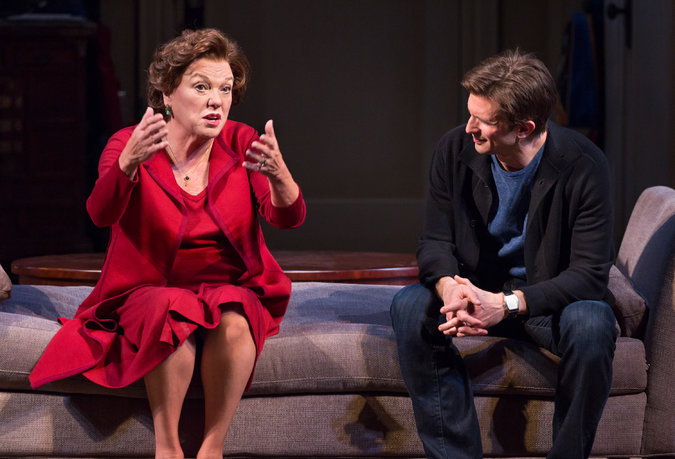
All of the feelings. All. Of. The. Feelings.
Terrence McNally’s new Tony-nominated play Mother and Sons caught me completely off guard. I was offered free tickets the night before (thanks Danny!), and before I knew it, I was sitting in the Golden Theatre with my good pal Marianne and was in for a very intense, yet incredibly funny, ride. Talk about a charged hour and a half. You can feel it in the house. Once the audience quiets down enough to truly listen, you can hear a pin drop as the characters walk around on eggshells.
We open on a mother (the excellent Tyne Daly) and her son’s ex Cal (Frederick Weller), together at his apartment on the Upper East Side where he lives with his husband and young son. We learn very quickly how she (Katharine) feels about homosexuals, her son Andre’s previous relationship with Cal, and what ultimately ended up happening to Andre. I’m not going to give anything away, not that these are monumental secrets, but the pace at which they’re revealed is important, and I don’t want to get in the way of that.
The performances are excellent. It was great to see Frederick Weller in this role, because the last time I saw him he was playing the classic best friend jack-ass in a Neil LaBute play. Bobby Steggert as his husband Will is also wonderful. And the little kid (Grayson Taylor)! I can’t even talk about it. He does such a great job. I’d never seen Tyne Daly live, and she is a force to be reckoned with. What a presence. The entire time! She creates such a nuanced, deep, striking character. The audience knows this person. We know not to mess with this woman, and yet simultaneously, we know she’s ready to break.
The play feels a little long, and as Mare pointed out, there are some repeated beats, moments of thinking “we’ve been here before,” but at the same time it remains effective. You know something is working when a character that is never seen has that much power over a room and not just over the characters but the audience as well. Katharine’s son Andre exists only in their words and our imaginations, but he may as well be on stage with everyone else.
It’s also told in real time which I personally love and have been thinking about a lot recently because The Understudy is in real time. It’s exciting for an actor to get to tell a story from the literal start to finish. There’s a change over the course of a play in general, but when it’s in real time, that change is not only over the course of the play but that particular hour and a half. Those 90 minutes have to be awfully powerful in order to warrant a story, and this one succeeds. The last twenty minutes really struck a chord with me. All of a sudden I found myself sobbing. It was an unexpected cathartic experience. I don’t remember the last time a play triggered me in this way. To go from a few controlled tears to ultimate ugly-cry-mode was not what I had expected, but boy, did it feel good.
Mothers and Sons
Written by Terrence McNally, Directed by Sheryl Kaller
Golden Theatre, Closing June 22nd
Photo Credit: Sara Krulwich
Pictured: Tyne Daly and Frederick Weller

 Becca on Broadway