
The Last Ship
Posted: November 5, 2014 Filed under: Becca Doodle - Sad, Broadway, Drama, Musical | Tags: billyelliot, broadway, kinkyboots, musical, review, sting, the police, thelastship 2 Comments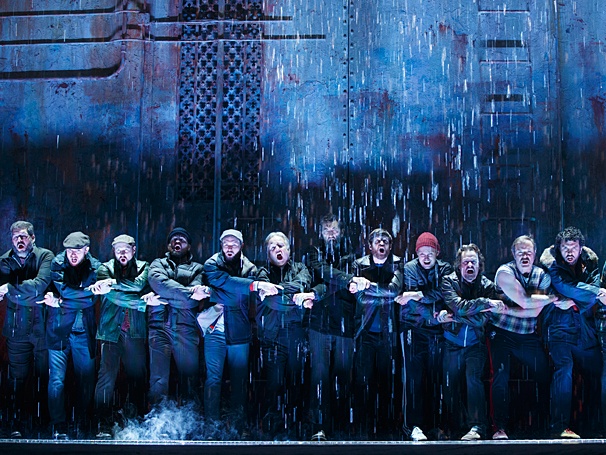
I think you’ll find that everything about Sting’s new musical The Last Ship feels very epic (click here for highlights). They certainly spared no expense with their advertising. The stakes are quite high for this small, English seafaring town, but unfortunately, it didn’t resonate with me. I think this may be because the book is trying to cover too much ground. It’s like an odd mix of Billy Elliot and Kinky Boots (or any other musical that takes places in the United Kingdom) – take out the miners and replace them with ship builders, trade out a son running away from his pop’s shoe business, and this time around, make it about, ya know, ships.
Let me see if I can describe the plot briefly (loosely based on Sting’s childhood). Gideon Fletcher is a young boy who is expected to build ships with the rest of the men in town, but he sees a different future for himself. He ditches his injured, abusive father and his ship-building roots to explore the world instead. He also leaves behind his girlfriend Meg. Fifteen years later he returns, and due to the economic depression, the shipyards have closed down, and his ex is engaged. Will Gideon return to his roots? Will he embrace the shipbuilders’ cause? Will he win back his girl?
Even though it seems like the show is pulling from all of the plots we’ve seen before, it is a new score. I think Sting has become one of the more successful pop/rock stars to shift into the musical theatre genre. Like Cyndi Lauper (Tony-winning composer of Kinky Boots), he’s got his own thing going on and has written a lush, dark score with an actual arc (something Spiderman could have used). Several melodies were very catchy, although the songs that were stuck in my head afterward may have been due to the fact that they were reprised approximately 13 million times.
Alongside the solid score is a very cool set design and a strong cast. Rachel Tucker as Meg has a great voice and presence. Fred Applegate (her father and the town preacher) is reliable as always; he brings some of the much-needed humor to the piece. I like Michael Esper (Gideon), but it also took me till about halfway through the first act to start understanding whatever he was singing about. I could not get my ears to wrap around his accent. Collin Kelly-Sordelet brings a tough innocence to his performance as Tom Dawson, Meg’s 15-year-old son (hmmm, I WONDER who the father could be?).
Here are some of the reasons I had trouble with the story. One of the biggest plot points is that these men aren’t going to be allowed to build ships anymore. So they start a revolution and resolve to build one anyway – one last, this-is-gonna-be-the-best-ship-ever – but for what purpose I don’t know; it’s never made clear. Then, the protagonist’s big shift in the end of Act I which ultimately builds to the finale, didn’t do anything for me. His decision to all of a sudden go from completely indifferent to caring passionately about a cause came out of nowhere. Dramatically you need more of a believable transition to go along for that ride. There simply wasn’t time to spend on his character shift, much less the supporting characters. Most came across as one-dimensional, there only to serve one purpose. The love triangle also drove me crazy. It’s like it only exists because it’s expected in a musical. This guy returns after 15 years and starts making moves on the woman he left behind, leaving her conflicted as to whether she should stay with her long-term, kind, committed, hot (thank you, Aaron Lazar) boyfriend. Are we really supposed to be rooting for Gideon to win her back?
The book is trying to cover so many different things that it leaves us with majorly underdeveloped characters. They remain archetypes: the rebel, the scorned woman, the adamant ship-building guys, the wide-eyed boy, the sarcastic preacher who drinks, the dedicated boyfriend who is also apparently the guy in charge of keeping the shipyards closed down…I didn’t really understand that part.
Despite a talented cast, haunting score, and exciting design, The Last Ship’s story will unfortunately leave you out to sea.
The Last Ship
Music by Sting, Book by John Logan and Brian Yorkey, Directed by Joe Mantello
Neil Simon Theatre, Closing January 24th, 2015
Photo Credit: Joan Marcus
Pictured: Fred Applegate, Jimmy Nail, and the cast of The Last Ship
Video Friday: The Writing on the Wall
Posted: October 31, 2014 Filed under: Videos | Tags: belting, bettybuckley, broadway, cats, edwindrood, grizabella, stephaniejblock, themysteryofedwindrood, thewritingonthewall, videofriday 2 CommentsHappy Halloween, Broadway fans! Let’s dedicate this Friday’s post to the crazy belting pipes of Betty Buckley. Cats’ original Grizabella also originated the title role in The Mystery of Edwin Drood in 1985 and got to sing the big number, “The Writing on the Wall.” It’s a damn good song with a great build to the closing moments of the show, especially since the first quarter of the number is mostly spoken.
I, for one, during the revival of Drood, was eager for the finale, knowing we would finally get to hear the belting chops of Stephanie J. Block. I imagine the same went for those watching Betty back in the day (in a higher key at that!!).
Here is Betty’s performance. Disclaimer: the video/audio quality is poor (yay old bootlegs); skip ahead to 1:04 to get to the singing part of the number.
And in the 2012 revival, here is Stephanie!
Do you have a favorite?
The Real Thing
Posted: October 22, 2014 Filed under: Becca Doodle - Sad, Broadway, Drama, Play, Revival | Tags: broadway, cynthianixon, ewanmcgregor, itsaboutyou, maggiegyllenhaal, moulinrouge, review, roundabout, samgold, therealthing, tomstoppard Leave a comment
If you went to high school with me, then you know I fell in love with Ewan McGregor when I was 17-years-old, saw “Moulin Rouge” for the first time, and my young mind exploded. You also know that I had a Seth Green phase earlier in high school, but let’s move past that for the moment. After I proceeded to watch as many of Ewan’s films as I could the following year, I eagerly awaited the moment to see him in a live play (since I tried and subsequently failed to see him in Guys and Dolls when I was studying abroad in England). So yes, I admit, Ewan was the primary reason I wanted to attend the newest revival of Tom Stoppard’s The Real Thing.
Henry (Ewan McGregor) is a playwright. His current play is about a woman who cheats on her husband, starring his wife Charlotte (Cynthia Nixon) and an actor named Max (Josh Hamilton). In real life, Max is married to Annie (Maggie Gyllenhaal). When we learn that Henry and Annie are actually having an affair, art begins to imitate life. Or is it the other way around?
Sadly, this production left me wanting in many ways. I wasn’t invested in these characters, emotionally or intellectually. They don’t need to be sympathetic (which they aren’t) for me to be invested, but I still have to want to go on a journey with them. Instead I felt left behind. This was in part due to the story itself being confusing at times (intentionally), and it can be hard to follow because the language is so dense. But that aside, I couldn’t connect to the style itself. It was very presentational and plotted out. Rather than discovering on the line, all of the words seemed planned. If a character had a big speech, it was performed like he or she had memorized it and had reached the appropriate time to recite it. It did not feel spontaneous.
Matt and I were discussing that maybe this was because of the slightly heightened, highly intellectual language, but on the other hand, Shakespeare is heightened and poetic. Even if you don’t catch all of the metaphors, subtext, and meanings in the first hear-through, you are still with the characters. You’re discovering things together, in the moment, no matter the density of the words. For example, when I saw the revival of Stoppard’s Arcadia a few years back, I went in blind, and while I was desperately confused at times (lots of math talk in that play), I still felt like I was there with the characters, going through something with them, trying to figure it out together.
The Real Thing won a Tony Award for Best Play in 1982 and Best Revival of a Play in 2000. It took home the Drama Desk, and the leads won Tony Awards in both productions. I mean, it makes sense! Stoppard is one of our most popular playwrights, known for his intense, philosophical, beautiful dialogue and topics. And I love all four of these actors in their other works. I think the root may be a direction/style choice. I’m curious what the previous productions did differently that made them so successful.
This play is about love, marriage, and in/fidelity. It’s about the feelings that are left unsaid, acting the opposite, playing it cool. We find out rather quickly that the first scene is a performance, a play within a play, but come the second scene in “reality,” it still feels like a performance. This might have been the point, as it partly represents the lack of honesty being shared among the characters, but then again, there needs to be a contrast. There are only a couple of moments with that kind of truth sprinkled in (Ewan has a touching moment alone onstage in the second act that I appreciated). I don’t mean that the characters need to show this truth to each other, but the vulnerability could be shared with us. Someone should be honest with the audience and make that connection, if only for a moment, because we want, we need the real thing.
The Real Thing
Written by Tom Stoppard, Directed by Sam Gold
American Airlines Theatre, Closing January 4, 2015
Photo Credit: Joan Marcus
Pictured: Maggie Gyllenhaal and Ewan McGregor
You Can’t Take It With You
Posted: October 8, 2014 Filed under: Becca Doodle - Happy, Broadway, Comedy, Play, Revival | Tags: annaleighashford, broadway, comedy, jamesearljones, kaufmanandhart, kristinenielson, mastersofsex, review, rosebyrne, youcanttakeitwithyou 3 Comments
What. A. Ball. I knew I would have a good time at You Can’t Take It With You, but I didn’t know I would have that good a time. And what a great way to be introduced! I had never seen the play, the movie, nor the short-lived 80s sitcom (of which you have to watch the trailer). Who knew such an old-school play could feel so new and contemporary? And I mean, olllld. This play, written by Moss Hart and George S. Kaufman, originally opened on Broadway in 1936 and won the Pulitzer in 1937 (click here for a little more history). It has since had several revivals, and I firmly believe Broadway will welcome back this most recent production with open arms.
I love this kind of screwball comedy. It doesn’t quite fall into the farce category, but it is still a full-fledged comedy packed with slapstick, visual gags, witty humor, and hilarious situations. What I like is that the humor is not relying fully on misunderstandings and mix-ups (except, albeit, for one big one); rather it generates from the quirkiest, happiest family you’ll ever meet.
The Sycamores live together in New York. All of them. Mom, Dad, Grandpa, daughters Alice and Essie, and Essie’s husband Ed. Plus the maid, her boyfriend, the dance teacher who is always there, and the delivery guy who never left. It’s actually a surprise to see such a big cast up on stage, and it’s wonderful, especially with this group of performers, but I’ll come back to that. Let’s return to the plot. Alice has fallen in love with Anthony Kirby, son of Mr. Kirby, president of Kirby and Co. down on Wall Street. The Kirbys are, to put it lightly, a little more straight-laced than the Sycamores, and Alice worries that the two families meeting might ruin any future she could have with Tony. When the Kirbys come over for dinner on the wrong night and the Sycamores are going about their evening in true Sycamore fashion, things go awry very quickly (much to our delight).
It’s hard to describe the Sycamore family in words; so much of what makes them hilarious and “out there” is visual. The walls of their house alone give you an idea of what these people are like. But despite how “crazy” they may or may not be, there is so much love in this family. They are genuinely happy to be together and to be going about their business. And with a cast like this, you’ve never been in better hands.
Now comes the time in my review when I stop everything to talk about Annaleigh Ashford. If she does not get a Tony nomination for her performance, I will picket Broadway. I have loved her since the days of Legally Blonde. From Dogfight to her Tony-nominated performance in Kinky Boots, and now that I’m an avid viewer of “Masters of Sex,” I can’t get enough of her these days. Now she’s playing Essie in a show packed with stars and winning performances all around, and she still practically steals the show. I, for one, in the big group scenes, couldn’t help but watch whatever the heck she was up to. Her grasp of physical comedy is amazing, and her line deliveries are like no other.
Okay, I think I got my gushing out of my system. Other standouts include Will Brill as her husband (just wait until you see his physicality); they make an hysterical pair. Kristine Nielson, as you know, is another favorite of mine (she plays Penny, the mother). Then there’s Reg Rogers as Essie’s Russian dance teacher, who always gets me; Julie Halston who stops the show by walking up the stairs; Rose Byrne making a great debut; and I haven’t even mentioned James Earl Jones or the rest of the brilliant cast.
I’m telling you now, readers: get thee to the Longacre for a joyous couple of hours packed with belly laughs and smiles that leave your face exhausted. Just do yourself a favor, and go spend an evening with the Sycamores. You won’t be sorry.
You Can’t Take It With You
Written by George S. Kaufman and Moss Hart, Directed by Scott Ellis
Longacre Theatre, Closing February 22nd, 2015
Photo Credit: Joan Marcus
Pictured: Annaleigh Ashford and Reg Rogers
The Curious Incident of the Dog in the Night-Time
Posted: September 30, 2014 Filed under: Broadway, Drama, Play | Tags: alexsharp, broadway, christopherboone, curiousincident, markhaddon, review, thecuriousincidentofthedoginthenighttime, westend Leave a comment
I liked this play a lot. It wasn’t necessarily life-changing, and I wouldn’t necessarily insist that you need to pay full price for a ticket, but I would say that if you have the opportunity to go, take advantage of it for a unique theatrical experience.
For the people out there who have not read the book (or the people who have and simply forgot everything about it like me), The Curious Incident of the Dog in the Night-Time came out in 2003, written by British novelist Mark Haddon. It’s about a 15-year-old boy named Christopher Boone. Christopher is extremely gifted in math, logic, and all things science, but he struggles socially. He doesn’t like when people touch him. He is easily overstimulated and screams until he is able to calm down. He has a complicated relationship with his dad and maybe an even more difficult relationship with his mother before she passed away two years earlier. The story begins with a neighbor’s dog being murdered. And à la John Coffey in The Green Mile, Christopher is found cradling the dead dog and is immediately accused. He makes it his mission to find out who did it and starts detective work even though he doesn’t like talking to strangers. But as he starts to dig, other mysteries begin to unravel as well, forever changing his life as he knows it.
The production (a transfer from the National Theatre in London) is very innovative and smart. It’s well-directed, and the design is arguably the best part. The creative team has done an excellent job of making the audience feel – or at the very least, understand – how Christopher feels day-to-day. In one scene, he explains that he “sees everything.” You know how Raymond counts the toothpicks in a split second? Like that, Christopher registers every single thing around him. Therefore, if he’s in a crowded place like a train station, it’s an unreal amount of stimulation that overwhelms and cripples him until he is able to find a rhythm to the madness. This then guides him back to his own personal equilibrium. So, through a slick scenic design, charged music, flashing lights, and incredibly well-used projections, the stage transforms into what’s going on in his brain during these moments. It can be very unnerving at times (in the best way possible). With such an effective design and moving choreography, the creators have set up a great storytelling convention for us to go directly into this kid’s mind. Now that I think about it, even in the calmer sections, the design is still how Christopher sees the world – like a grid, finding whatever sense he can in his surroundings. For example, he builds a train set throughout Act 1, literally taking the different pieces out of the walls around him. Everything is compartmentalized, organized, and clean…until it’s not, and he panics. Christopher is wonderfully played by Alex Sharp, a 25-year-old recent graduate of Juilliard (and by recent, I mean this past May). You’re looking at a future Tony nominee, folks.
Now this isn’t exactly a heads-up per se, but I feel like I should note again that this production came over from the West End, and you can definitely tell. This is British theatre at its core. It’s hard to explain what I mean by that. Basically, the style is different – the way of storytelling, the pacing, etc. Quite often, it can be tricky for plays to make the jump across the pond for these very reasons. Sometimes, American audiences have a difficult time adjusting to the style shift. I’m very curious to see what the critics will think. I personally like that it’s structurally different and that the storytelling makes you work, although the pacing was often a problem. I was bored at times, and it’s a little long. Granted, I saw it in the middle of previews, so this may change (they even had to hold for a few minutes during Act 2 due to technical difficulties. Ohhh previews.).
So my bottom line? It’s a striking design and a very, very technical show, but what’s lovely – and crucial – is that amidst all the flash and spectacle, Curious doesn’t lose its heart.
The Curious Incident of the Dog in the Night-Time
Written by Simon Stephens, Based on the novel by Mark Haddon, Directed by Marianne Elliott
Barrymore Theatre, Open-ended
Photo Credit: Joan Marcus
Pictured: Alex Sharp

 Becca on Broadway