
Bad Jews
Posted: November 18, 2013 Filed under: Comedy, Off-Broadway, Play | Tags: badjews, chai, review, roundabout, shiksa Leave a comment
First, let me say that I did not care for this show. Second, I should also say right off the bat that I am most definitely in the minority. Bad Jews has received rave reviews and audiences love it. My theatre buddy that evening (and fellow Jew) was my brother’s girlfriend, Allison (of Accessories by ASH), and she loved the show, too.
So what’s wrong with me you ask? Well, let’s back up a bit. We start in a fancy New York City studio with Jonah and his first cousin, Daphna (actually named Diana, but she’s super Jewish so she’s Daphna now, don’t bring it up) after their grandfather’s funeral. They are soon to be joined by Jonah’s brother, Liam, who arrives late (missing the funeral) with his Shiksa girlfriend, Melody. Tensions are immediately high, yes due to the death in the family, but primarily because Daphna is “that cousin” who gets in your face about everything. She and Liam can’t stand each other. Jonah would prefer to stay out of the drama as much as possible. As the fighting enters into the wee hours of the morning, these four characters brawl over their feelings toward Judaism, marrying outside the faith, how to best honor their grandfather, and above all who should receive Poppy’s Chai necklace that he’s had since the Holocaust.
Now I went into this play thinking I was going to see a slapstick comedy about Jews. The play does have some good laughs (there is one bit with Molly Ranson as Melody and I could hardly breathe), but this is no farce. There are serious issues being covered, and very intense words are shared. Thoughtful questions are raised and interesting perspectives put out there, but the way in which they are approached is what put me off. I want to hear these arguments but not from these people. For example, the second Liam is introduced he is a jackass through and through with no redeeming qualities. Why do we start with him there? There isn’t anywhere for him to go if he’s already so terrible.
It’s hard to watch people fight for close to two hours. It’s hard to watch unlikable people tear each other down with cruel words. Some of what these characters say is exactly that: cruel. They are bullies, pure and simple. There are two monologues in particular that are full of hateful words directed at another person in the room. Luckily there comes a point when someone steps in, but I as an audience member didn’t see why we had to watch it. Charles Isherwood calls it savage humor, and apparently it’s just not my style. I only felt a consistent sense of unease.
Maybe the discomfort I felt during the show is part of the playwright’s intention; perhaps he wants to ruffle some feathers. But instead, I felt like Jonah – stuck in the middle and not wanting to get involved.
Bad Jews
Written by Joshua Harmon, Directed by Daniel Aukin
The Laura Pels Theatre through December 29th
Photo Credit: Joan Marcus
Pictured: Tracee Chimo, Philip Ettinger, and Michael Zegen
Luce
Posted: November 15, 2013 Filed under: Drama, Off-Broadway, Play | Tags: congo, jclee, lct3, lincolncenter, luce, review Leave a comment
Lincoln Center is full of “thinker” plays right now. Luce, currently playing at the Claire Tow Theatre through the LCT3 program, prompted another evening full of conversation as my theatre companions and I debated what actually went down during those 100 minutes.
Luce marks the New York professional debut of JC Lee, an up-and-coming playwright and recent graduate of the Juilliard playwrighting program. He grew up with one of my best friends so I’ve known JC for a while now. I was even in a play of his back in 2007 in trusty ol’ Allentown, PA called The Nature Line. His dialogue is quick, smart, contemporary, and often provocative. His new play brings up some interesting ideas about stereotypes, privacy, student/teacher relationships, culture, etc.
As things kicked off, I wasn’t completely gung-ho about this production. The first scene turned me off. It felt forced on the acting front with everything being spelled out for us, and the blocking felt false and unnatural. Once I disengage, I admit it’s hard to bring me back from the edge, but after a couple more scenes, I was definitely drawn back in and more engaged.
So we’ve got a boy named Luce, a 17-year-old kid from the Congo. He was adopted when he was seven years old by Amy and Peter, rescued from the war, and brought over to the states. He’s now a high school senior football player, hoping to get recruited. He’s an A student, popular, and everything his adoptive parents could hope for. Look how this poor boy turned out despite his past! He’s a dream poster child to everyone around him. But after some trouble starts to brew with one particular teacher, warning flags start popping up. When the teacher discovers illegal fireworks in his locker and brings in Amy for a little parent-teacher meeting, the plot is set in motion and we get to watch how his parents handle (or don’t handle) the situation. As things escalate, we are left to wonder: Is Luce innocent? Is he still plagued by his childhood and now acting out?
Although I had trouble with some of the direction and acting, I think this was an exciting debut. The ambiguity of Luce’s innocence lasts the majority of the play. Although even that ambiguity is arguable. My friend made up her mind about Luce’s actions much earlier in the play than I did. We heard an adorable older woman leaving the play afterward saying, “I just don’t know what to think!” I personally don’t think the play leaves much doubt as to whether Luce is guilty or not of a certain act. It’s definitely left up to the audience until those last few minutes, but even then, one could argue it still isn’t 100% one way or the other. Most signs point to guilty, but do we give him the benefit of the doubt? I know I did. But is that only because I, like his mother, so desperately want him to be innocent because of his past? The play asks many questions: how much privacy should a teenager be allowed? Who’s really at fault here? But I left asking primarily: how far would you go to protect your child and your child’s future, no matter his past?
Luce
Written by JC Lee, Directed by May Adrales
Lincoln Center Theater through November 17th
Photo Credit: Jeremy Daniel
Pictured: Marin Hinkle, Okieriete Onaodowan, and Neal Huff
Julius Caesar
Posted: November 8, 2013 Filed under: Drama, Off-Broadway, Play, Shakespeare | Tags: allwomen, juliuscaesar, review, shakespeare, stanns 1 Comment
I was very excited to see the all-female production of Julius Caesar at St. Ann’s Warehouse, directed by Phyllida Lloyd and brought over from the Donmar Warehouse (a fantastic theatre in London). I know that sentence sounds like a set up for the show being disappointing. And it wasn’t, but at the same time, I also wasn’t as blown away as I’d hoped to be. Perhaps I went in with expectations too high. This happens to me more often than I’d like.
But after thinking it over since this particular Halloween outing last Thursday, I think the underlying issue is that I am simply not a big fan of the play. Is that sacrilegious to say, Shakespeare fan that I am? Caesar has never done much for me as a reader or audience member. I’ve been trying to figure out why, and I keep coming up relatively empty. Is it because I have trouble relating to the story? Do I not sympathize with any of the characters? Unclear.
Given that the story bores me, this production did a pretty decent job of holding my attention. First off, it is set in an all-female prison #orangeisthenewblack. The audience is escorted by extremely stern guards (ushers) into a sterile prison of pipes and scaffolding and lectured about how to behave before being led to our seats. I love this kind of thing – immediately transporting us into a new environment and setting the scene before we even take our seats.
These (very talented) women tell the iconic story that we know so well, straying only occasionally from the classical text for a handful of contemporary references (e.g. the prophecy of Caesar’s demise is a Libra horoscope). They have a fantastic grasp of the language, and they also stick to all of the original pronouns, referring to each other as men. This is typically a very male-heavy show, but it should be noted that the power or strength of that overwhelming testosterone is not lost with this cast.
Lloyd plays with the location and convention of the prison throughout but not as much as I would have liked. These were the moments that particularly grabbed me and made me sit forward in my seat – the recognition and awareness of the surrounding reality, like in Alan Cumming’s Macbeth. If anything, this switched things up from the standard plot. Whether or not the play does anything for me though, the cast is fantastic, and you get the feeling when the show ends that there is still more story to be told.
Fun side note: I should mention that at one point during the show, during the big senate scene I believe, all of a sudden I noticed someone sitting upstage in one of the chairs. After a little while, I thought to myself, is that person a part of the show? That doesn’t look like a woman. Yup, that’s a man…holding a program – an audience member who somehow managed to take a seat within the set and then sat there for close to 15 minutes, from Caesar’s death scene (spoiler alert) up through Mark Antony’s huge monologue. He was practically one of the conspirators. Hi-larious.
Julius Caesar
Written by William Shakespeare, Directed by Phyllida Lloyd
St. Ann’s Warehouse through November 9th
Photo Credit: Helen Maybanks
Pictured: Harriet Walter
Let Them Eat Chaos
Posted: November 5, 2013 Filed under: Comedy | Tags: chicago, improv, letthemeatchaos, review, secondcity, sketchcomedy 3 Comments
Just a quick note.
If you find yourself in Chicago in the coming months, be sure to see Let Them Eat Chaos at Second City. No, I’m serious. You’re going.
This was my first time seeing a mainstage production at Second City. When I went the first time in 2007 while on tour, I think I saw a random improv class and I can’t say I enjoyed myself. This visit was a little better planned, and I went with a couple friends while in town a few weeks ago. And my lord, I don’t remember the last time I laughed so hard, so consistently.
The show is a mix of sketch comedy and improvisation, seamlessly intertwined and acted by six fantastic performers. It’s topical, political, and stupidly funny. Every sketch is more delightful than the last.
I don’t know about you, but sometimes I get nervous watching improv. I get very uncomfortable if a scene or performer is bombing. But during this performance, I was never once worried for the actors. They knew what they were doing at all times. Even if a moment wasn’t funny, it would work its way around to paying off. Everything eventually landed. And I was able to just sit back and let the professionals do their thing.
Long story long, my face hurt from laughing for over two and a half hours. And I could have stayed for another two.

Let Them Eat Chaos
Written by Edgar Blackmon, Ross Bryant, Holly Laurent, Tawny Newsome, Katie Rich, and Steve
Waltien, Directed by Matt Hovde
The Second City
Photo Credit: Clayton Hauck
Pictured: Steve Waltien, Holly Laurent, Edgar Blackmon, Ross Bryant, Tawny Newsome, Katie Rich
The Glass Menagerie
Posted: November 4, 2013 Filed under: Broadway, Drama, Play, Revival | Tags: cherryjones, gentlemancaller, glassmenagerie, review, revival, tennessee, williams, zacharyquinto 2 Comments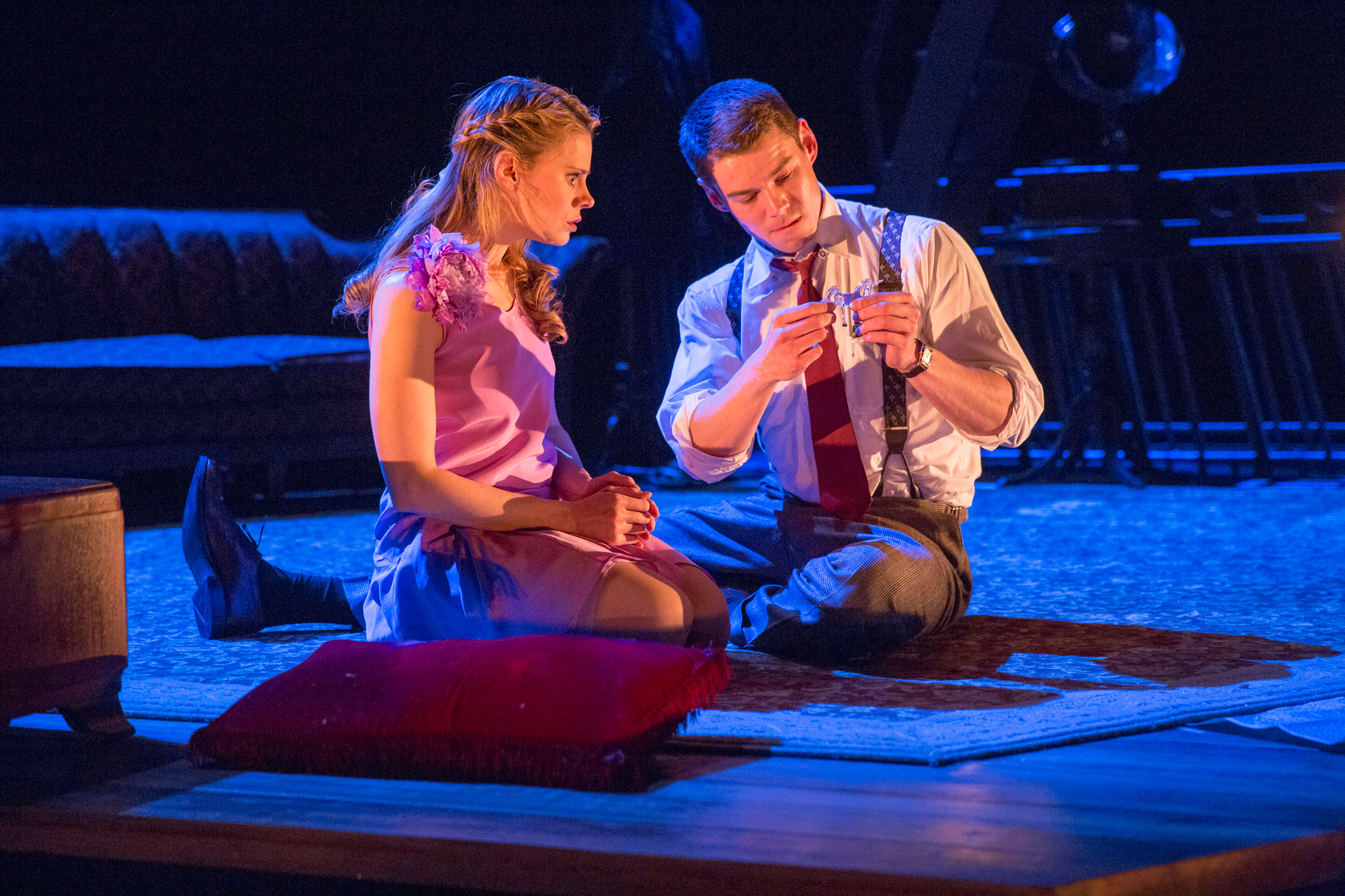
If you’ve spoken to anyone about the newest production of The Glass Menagerie on Broadway, then you already know that not one person has a bad thing to say about it. As a result, I feel like this review might end up being a little bit gratuitous – simply one more positive response to add to the mix. But if you’ll indulge me, it is a beautiful revival, literally and figuratively.
In its natural essence, as Tom states in the opening lines, Menagerie is a memory play, but I don’t think I’ve ever before seen the “memory” factor as effectively portrayed as it is in this production. We revisit Tom’s past by his side and see with his eyes what continues to haunt him to this day. Together we stumble back into his memories. Through stage magic and stylized movement, it feels almost like a dream. Which I’ve come to learn is exactly how this play should feel. This is one of those productions (similar to David Cromer’s production of Our Town at Barrow Street) where you leave thinking, “Oh. That’s how that play is supposed to be done.”
The set and lighting design alone create the space for Tom’s memories to take form. Much of the stage is dark with only certain pieces of scenery highlighted, patchy in the dark corners of his mind. There’s a fire escape that leads to nowhere and a home floating on a reflective surface. We too float in Tom’s memory. The memories are also physicalized through movement, repeated gestures, the appearance and disappearance of characters, private moments as characters loom over the edge of the living room.
Despite the beauty of the design elements, we know that most people see this play for the acting. These are four iconic roles, and across the board, these actors will not let you down. You might think you’re only going for Cherry Jones (Amanda) or to see Zachary Quinto (Tom), but Celia Keenan-Bolger (Laura) and Brian J. Smith (Gentleman Caller) are just as excellent. Quinto is enticing in his Broadway debut. His southern drawl draws everyone in from the opening moments. Keenan-Bolger gives a beautifully subtle performance as the extremely shy Laura. In the first act, she practically blends in with the scenery.
Now my experience of Amanda has always been the ultimate overbearing mother. She is a domineering, angry woman who feels burdened with her children and the abandonment of her husband. But Cherry Jones has changed my view. True, this woman is can be a lot to deal with day after day, but she cares deeply about her children. She wants the best for them and is desperately trying to lead them to “happiness and success.”
The brilliance of this play and John Tiffany’s direction is that the audience reaches intermission craving the arrival of the Gentleman Caller just as much as the Wingfields. We crave the new energy, a new character to shake up the status quo. Maybe he really will be the answer we’ve all been looking for.
Which brings me to the Gentleman Caller scene. I swear, sometimes I think that scene is all Tennessee Williams needed to write. It’s so real and beautiful and absolutely heart-breaking. This particular performance is so incredibly private and fragile; it feels like it’s just you, Jim, and Laura sitting together on the floor for hours. It was also a nice change to see a new interpretation of Jim. He isn’t portrayed as the perfect cut-out of a man. He has struggles of his own – with his work, his future, and his confidence. He and Laura aren’t so different after all. It’s astounding to me that in such a short amount of time, the entire audience can feel the same kind of crushing disappointment that Amanda feels and the guilt that plagues Tom.
The Glass Menagerie is going to be the piece that people talk about all season long. This production made me see this classic play in a completely new light. That’s the whole point of a revival, right?
The Glass Menagerie
Written by Tennessee Williams, Directed by John Tiffany
Booth Theatre through February 23rd
Photo Credit: Michael J. Lutch
Pictured: Celia Keenan-Bolger and Brian J. Smith

 Becca on Broadway