
It’s Only a Play
Posted: November 12, 2014 Filed under: Becca Doodle - Sad, Broadway, Comedy, Play, Revival | Tags: broadway, ferrisbueller, harrypotter, itsonlyaplay, matthewbroderick, mcnally, meganmullally, nathanlane, newyorkreview, newyorktheatre, review, ronweasley, rupertgrint, stockardchanning, terrencemcnally, thenance, theoddcouple, theproducers Leave a comment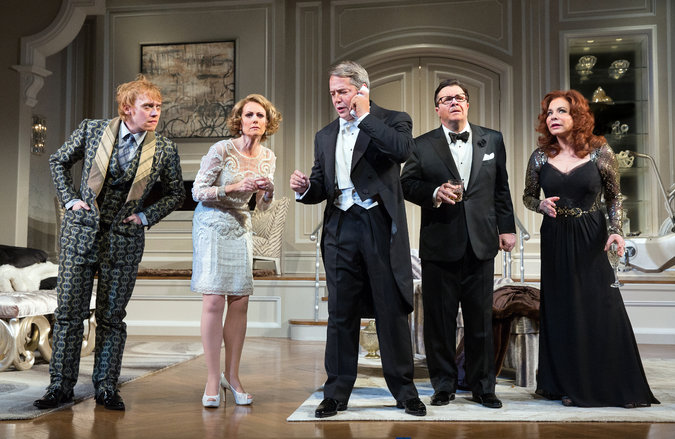
This Terrence McNally revival packs a lot of star power but no punch.
Listen folks, I’m sorry to report that I was disappointed by It’s Only a Play. Matt and I were very much looking forward to it, and being that it’s one of the hottest tickets, this was one of our splurges money-wise this season. With its starry cast, stellar creative team, and modernized script, we figured we couldn’t go wrong.
The loose plot centers around a group of theatre people at an opening night party awaiting the reviews, primarily the Times. You’ve got the producer (Megan Mullally), the playwright (Matthew Broderick), the director (Rupert Grint), the star (Stockard Channing), a critic (F. Murray Abraham), the playwright’s friend who passed on the project (Nathan Lane), and the coat check boy (“introducing Micah Stock”). All in one room told in real time (click here for highlights).
Things start out amusingly enough. I mean, I’ll watch Nathan Lane live anytime with a perfectly content smile on my face. There’s a section early on with just him on stage, and I would have been happy if the whole play had been that. Maybe I’ll go watch The Nance on PBS instead and revisit that production.
It’s Only a Play is overflowing with inside jokes about the theatre world, many of which would completely go over the average theatre-goer’s head. McNally has updated all of the now-dated references to today’s celebrities and to more recent theatre tiffs (e.g. Shia LaBeouf, Alec Baldwin). Practically every show currently running on Broadway is thrown into the mix, and it gets old fast. There is more name-dropping in this show than…um…just trust me. Hilary Clinton, Denzel Washington, Frank Langella, Lady Gaga, a whole lotta names – most of which are mentioned alongside jokes at their expense. There are so many punchlines that are equivalent to a celebrity shout-out that it started to get on my nerves. Those are cheap shots in my book (although the malicious jokes didn’t seem as malicious coming out of Lane’s mouth).
Matthew Broderick’s stiff performance falls flat with his consistently understated and monotone delivery. Any energy that is built up by the other characters collapses around them when he arrives onstage. He has a huge speech in the first act (which ends with the line: “Speech done”) when he gets up on a soap box and talks about the theatre today and how its integrity is basically falling apart at the seams. What have we done to it? Remember the good old days? And so on and so forth. People applauded like crazy afterward, yet I sat there feeling insulted. I understand the self-awareness aspect of referencing the trend of movie stars taking over Broadway and names above the title, and that’s what this play is doing too (get it??), but it didn’t come across as witty to me. [title of show] did the self-aware comedy much more effectively and humorously. Nathan Lane’s character referring to the actor Nathan Lane for an easy laugh? Come on. There was so much applause after lines, big speeches, entrances, and exits, I couldn’t wrap my head around it. Were the people around us clapping for the play? The production? Or just the stars they love? Does Stockard Channing leaving the stage after saying something triumphantly warrant exit applause? If it had been any other actor, would the audience have cared?
Wow, I’m starting to sound bitter. Let me dial it back, and get back on topic. Take a breath, Becca.
Perhaps I’m not the target audience. I know that the most of the reviews tell me I’m in the minority, but neither Matt nor I laughed much. Grint was a caricature, as was Mullally. This approach could maybe work if everyone was giving the same stylized performance, but with Broderick, for example, playing everything down, you’re left with a bunch of people in different plays. One of the things that makes You Can’t Take It With You such a hit in my book is that it has a cast of fully-realized individual characters who all could be the star of the show with their crazy antics, but simultaneously, they’re in sync with one another. That family is under the same roof and in the same play, whereas It’s Only a Play’s characters all seem to be attending different opening night parties.
It’s Only a Play
Written by Terrence McNally, Directed by Jack O’Brien
Schoenfeld Theatre, Closing January 4, 2015
Photo Credit: Sara Krulwich
Pictured: Rupert Grint, Megan Mullally, Matthew Broderick, Nathan Lane and Stockard Channing
Mothers and Sons
Posted: June 17, 2014 Filed under: Broadway, Drama, Play | Tags: bobbysteggert, broadway, frederickweller, gaymarriage, mcnally, mothersandsons, review, terrencemcnally, tynedaly Leave a comment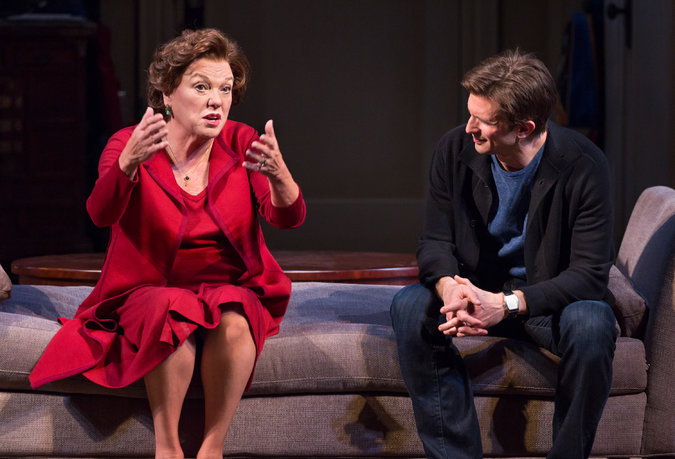
All of the feelings. All. Of. The. Feelings.
Terrence McNally’s new Tony-nominated play Mother and Sons caught me completely off guard. I was offered free tickets the night before (thanks Danny!), and before I knew it, I was sitting in the Golden Theatre with my good pal Marianne and was in for a very intense, yet incredibly funny, ride. Talk about a charged hour and a half. You can feel it in the house. Once the audience quiets down enough to truly listen, you can hear a pin drop as the characters walk around on eggshells.
We open on a mother (the excellent Tyne Daly) and her son’s ex Cal (Frederick Weller), together at his apartment on the Upper East Side where he lives with his husband and young son. We learn very quickly how she (Katharine) feels about homosexuals, her son Andre’s previous relationship with Cal, and what ultimately ended up happening to Andre. I’m not going to give anything away, not that these are monumental secrets, but the pace at which they’re revealed is important, and I don’t want to get in the way of that.
The performances are excellent. It was great to see Frederick Weller in this role, because the last time I saw him he was playing the classic best friend jack-ass in a Neil LaBute play. Bobby Steggert as his husband Will is also wonderful. And the little kid (Grayson Taylor)! I can’t even talk about it. He does such a great job. I’d never seen Tyne Daly live, and she is a force to be reckoned with. What a presence. The entire time! She creates such a nuanced, deep, striking character. The audience knows this person. We know not to mess with this woman, and yet simultaneously, we know she’s ready to break.
The play feels a little long, and as Mare pointed out, there are some repeated beats, moments of thinking “we’ve been here before,” but at the same time it remains effective. You know something is working when a character that is never seen has that much power over a room and not just over the characters but the audience as well. Katharine’s son Andre exists only in their words and our imaginations, but he may as well be on stage with everyone else.
It’s also told in real time which I personally love and have been thinking about a lot recently because The Understudy is in real time. It’s exciting for an actor to get to tell a story from the literal start to finish. There’s a change over the course of a play in general, but when it’s in real time, that change is not only over the course of the play but that particular hour and a half. Those 90 minutes have to be awfully powerful in order to warrant a story, and this one succeeds. The last twenty minutes really struck a chord with me. All of a sudden I found myself sobbing. It was an unexpected cathartic experience. I don’t remember the last time a play triggered me in this way. To go from a few controlled tears to ultimate ugly-cry-mode was not what I had expected, but boy, did it feel good.
Mothers and Sons
Written by Terrence McNally, Directed by Sheryl Kaller
Golden Theatre, Closing June 22nd
Photo Credit: Sara Krulwich
Pictured: Tyne Daly and Frederick Weller

 Becca on Broadway