
ROCKY
Posted: March 12, 2014 Filed under: Broadway, Musical | Tags: adrian, ahrensflaherty, alextimbers, andykarl, margoseibert, musical, review, rocky, rockybalboa, rockybroadway, rockymusical, slystallone, sylvesterstallone, wintergarden Leave a comment
Well, that was a surprise. I gotta say: I was wary going into ROCKY – and admittedly even remained so on and off throughout Act I – but man oh man, this new musical may be the shock winner of the season. I think you all need to prepare yourselves for a whole lot of “ROCKY is a Knock-Out” headlines.
Before I dive into the details, let me get this out of the way first: I have never seen the movie. I know! I know! None of them! I should get on that stat. I think it gave me a unique perspective though, since I would guess most people attending know the films quite well.
Act I is relatively solid. There is a lot of exposition to cover, and it takes a little time to find its groove, but things kick into gear with Adrian’s first big song, “Raining.” For me though, Act II is where the show totally takes off. It’s non-stop, high energy, and reaches ultimate entertainment value. And have no fear – it includes all of the iconic moments you would expect from a Rocky musical. The training montages are kick-ass. There are Rockys everywhere! Instead of multiple Phantoms crossing bridges or lots of Spidermen flying across the stage, now you get Rockys in grey sweats. Also, the projections of the streets of Philadelphia as he trains are great and manage not to go overboard – what Ghost the Musical was trying to do and failed. Ghost looked over-produced whereas this just looks cool. Cool is key if you’re going to put Rocky Balboa in musical format. Who knew they could successfully make that character sing?
The leads are very strong. There’s the always-reliable Andy Karl in the title role. You may have seen Andy in The Mystery of Edwin Drood, Jersey Boys, or perhaps as the UPS guy in Legally Blonde, to name a few. But this is his first “carrying-the-show” role. He plays a reserved, tough Rocky and doesn’t make a parody out of the iconic Sly impression. He makes it his own yet still honors certain aspects of Stallone’s performance. And then you have Margo Seibert making her exciting Broadway debut as Adrian. And damn, this girl can sing. Here’s an inside look at both the stars and the show itself.
The book was co-written by Stallone and Thomas Meehan (whose award-winning work includes Annie, The Producers, and Hairspray). The new score is written by Lynn Ahrens and Stephen Flaherty, the Tony-winning writing team of Ragtime, A Man of No Importance, and Once on This Island. Or perhaps you’re a fan of the animated film, Anastasia (I sure am). The ROCKY score is full of power ballads, sweet duets, and everyone’s favorite pump-up song, “Eye of the Tiger.” And of course there’s the man of the hour, director Alex Timbers, who returns to Broadway with yet another innovative experiment in new theatricality.
I so want to tell you about what they do for the big fight in the end, but I don’t think it would be fair of me to spoil it. Just know this: it’s awesome. I’ve never seen anything like this in a theatre. It’s excellently choreographed and packed with fantastic lighting and super cool effects. The last 20 minutes were so exhilarating that Matt and I ran out of the theatre with the beat thumping in our heads and our hearts racing. The audience was so worked up by the 15th round that we were all cheering together on the literal edges of our seats. I was practically on my feet shouting “Adrian” too.
This production may just be the punch Broadway doesn’t see coming. Go see it!
ROCKY
Music by Lynn Ahrens and Stephen Flaherty, Book by Thomas Meehan and Sylvester Stallone, Directed by Alex Timbers
Winter Garden Theatre, Opening March 13th
Photo Credit: Matthew Murphy
Pictured: Andy Karl and Terence Archie
Outside Mullingar
Posted: March 3, 2014 Filed under: Broadway, Comedy, Drama, Play | Tags: debramessing, doubt, doughughes, johnpatrickshanley, manhattantheatreclub, mtc, outsidemullingar, review Leave a comment
Outside Mullingar is John Patrick Shanley’s newest play, and what a delight it is.
You likely know Shanley best from his 2005 Tony and Pulitzer prize-winning play Doubt, or perhaps his lesser-known work – but still a favorite of mine – the film Joe Versus the Volcano (check it out, it’s so weird). That Shanley can write such a range has always been noteworthy to me, and he’s done it yet again with this delightfully endearing piece. As Jenn, my companion for the day, joked afterward, “I think this guy’s got a real future.”
This production stars Debra Messing (of Will & Grace fame) and Brían F. O’Byrne (the always fantastic stage actor) as lifelong neighbors in the town of Mullingar, Ireland. It’s clear from their first scene that they’re meant to end up together, and we should simply sit back and enjoy the ride. So yes, it’s been rightly advertised as primarily a romantic comedy, but it also goes beyond the romance and covers larger themes (family struggles, death, madness). Watch some clips here.
There actually isn’t much I want to say about this play other than how much I liked it. You’ll see that the show speaks for itself. It’s so incredibly charming. Very, very funny. Great acting on all fronts. Excellent direction by Doug Hughes. An amazing, smart set design by John Lee Beatty. Plus the Production Stage Manager is my friend Winnie Lok!
It’ll make you laugh. It’ll make you cry. It’ll surprise you. It’ll close on March 16th. See it if you can.
Outside Mullingar
Written by John Patrick Shanley, Directed by Doug Hughes
Samuel J. Friedman Theatre through March 16th
Photo Credit: Joan Marcus
Pictured: Brían F. O’Byrne and Debra Messing
The Bridges of Madison County
Posted: February 4, 2014 Filed under: Becca Doodle - Meh, Broadway, Drama, Musical | Tags: bridgesofmadisoncounty, fallingintoyou, francesca, hunterfoster, iowa, jasonrobertbrown, kelliohara, moonlighting, review, robertkincaid, stevenpasquale, thebridgesofmadisoncounty 3 Comments
A few short weeks ago I wrote a post about the upcoming production of The Bridges of Madison County. It has since arrived on Broadway and is set to open on February 20th (check out photos here). So, how did it measure up to expectations? Honestly, it’s quite the mix.
Here’s the basic premise. It’s 1965 in Madison County, Iowa. We open on a housewife named Francesca (Kelli O’Hara), who lives with her husband Bud (Hunter Foster) and their two kids. Hubbie and the kids are heading out of town for a few days for some cattle steer contest thing that makes absolutely no sense to an East Coast girl like me. Fran is still adjusting to Iowan life. She’s originally from Italy and looks pretty darn bored with her daily chores in this flat town. Enter Robert Kincaid (Steven Pasquale)! He’s the dreamy, traveling photographer who pulls into town right when Fran’s family hits the road. Most everyone coming to this show knows that these two are destined to fall in love from the second he asks for directions to one of the covered bridges…of Madison County. And oddly enough, it’s these two we root for despite the fact that it’s an extramarital affair. Bud isn’t a bad guy by any means, but we still want this for Francesca.
The first act is like a beautiful, slow crescendo. It’s full of folksy tunes and soaring, lush ballads. It is also funnier than I expected. It’s hard to believe Steven Pasquale has never done a Broadway musical before, but finally audiences are getting a chance to hear his pipes, which of course sound amazing alongside the glory that is Kelli O’Hara (everything she touches is gold). The story relies on a strong bond between the two leads, and there is great chemistry between O’Hara and Pasquale. Over the course of Act I, the string on the violin is pulled tighter and tighter as the sexual tension builds between them. The ensemble isn’t used as effectively. They’re either under-utilized or one-dimensional. I like the snooping yet caring neighbor (Cass Morgan) for comedy purposes and also having a real face to the husband and kids out at the cattle event, but everything else somewhat fades to the background. Even the supporting characters feel like filler, because we are really just waiting for Robert and Francesca to be together.
It starts out so strong. All through the first half I was curious, longing for the next song, eager for the upcoming moment. That eagerness slowly faded during Act II. In fact, it turned into a distant memory. To sport a 90s reference, like the Energizer bunny, the show keeps going and going and going (running time is 2 hours and 35 minutes). The second act falls off track and turns into the same idea set to music over and over again. Want to hear another song about love? Here’s one. How about one about loss? Hit it! Oooh, love AND loss? That’s new! Bring it on. I know it sounds harsh, but I was disappointed to be disappointed.
I think it’s mainly a storytelling issue. After Robert and Francesca get together, there isn’t much left to cover or to fill the time. There is the fact that Fran is left with a decision to make: does she stay with her family or run off with Rob to take lots of pictures of bridges? The thing is, her decision is made sometime in Act II and then there is still another 20 minutes of material. All of a sudden we find ourselves in a montage time leap, jumping years into the future. I wonder if this happens in the movie/book as well. The plot problem reminds me of the “Moonlighting” curse which people like to bring up for every TV show known to man with a will-they-or-won’t-they couple. You know the drill: once a couple gets together, people assume the show will fall apart and lose viewers. I personally don’t think a relationship has to kill a show. Now, if the sexual tension was all the show had going for it, then there were problems to begin with. A couple can get together, but the writing has to keep up!
Musically, the two duets between Francesca and Robert are the big highlights: Falling Into You and One Second and a Million Miles. They also each have an 11 o’clock number, but by that point it’s all so repetitive we care less and less. Granted, it might just be me (and the people who were griping around me). I’m curious to see what the reviews will be and if changes are made during the preview period. I hear there are folks coming out of this show sobbing. So who knows? I like to think I’m a romantic and I always love to root for the couple, but the story left something to be desired after these crazy kids got together.
The Bridges of Madison County
Written by Jason Robert Brown and Marsha Norman, Directed by Barlett Sher
Gerald Schoenfeld Theatre, opening night February 20th
Photo Credit: Joan Marcus
Pictured: Kelli O’Hara and Steven Pasquale
No Man’s Land
Posted: January 15, 2014 Filed under: Broadway, Comedy, Drama, Play, Revival | Tags: beckett, captainpicard, cort, engaged, godot, haroldpinter, ianmckellen, nomansland, patrickstewart, pinter, pinteresque, rep, review, samuelbeckett, waitingforgodot, youshallnotpass Leave a comment
I try so hard with Harold Pinter. I loved studying him in school. I even wrote a “Pinteresque” one-act with my friend Sandy entitled The Bells for a class during senior year of high school (for a brief excerpt, see the end of this review). Pinter’s writing can be so funny and thought-provoking, but when I see productions, I don’t end up being as riveted as I had hoped. I understand his significance and place in theatre history, but the plays simply don’t do anything for my soul. I want to stress that this is not to say No Man’s Land is not a good production; it’s just not my taste. So please don’t let this review stop you from going to see it. The show has received rave reviews and rightly so. I think I’m just realizing that while I may appreciate Pinter, I don’t necessarily enjoy his plays.
No Man’s Land might be the one to see though, especially when you’ve got A-list actors like Ian McKellen and Sir Patrick Stewart sharing the stage. It’s pretty grand being in the same room with both of them. Their presence alone is effective. They can hold a room with no words at all, and the cast is nicely rounded out by the younger fellows, Billy Crudup and Shuler Hensley. But don’t expect to go, sit back, and let them do all the work – Pinter expects you to pay attention. There is so much subtext and double-meaning and subtlety to sift through in his language it can take up to 15 seconds to catch on to the fact that a joke was just made.
This production is currently playing at the Cort Theatre in rep with Samuel Beckett’s Waiting for Godot. The similarities between the plays are clear: there is a sense of isolation for these characters and feeling trapped in both pieces. And the audience must work hard to understand the given circumstances. In No Man’s Land, we wonder what these men’s relationships are. Where are we? Why are we here? What should we take away from this experience? Whatever you do, don’t expect clear answers. You might finish Act One with an idea about who these folks are and their relationship to each other, but then Act Two turns any semblance of an idea you once had on its head. All of a sudden you have to adapt to entirely new information. And then, for me anyway, the “plot” basically falls off any kind of trackable course. You can try your best to make it make sense, searching for linear storylines and/or relationships, but I think you’ll just end up more confused. As director Sean Mathias explains, “Pinter isn’t saying what he necessarily means or meaning what you might like to believe. Like Godot, No Man’s Land is a game of memory, of time elapsed and elapsing; dealing with things abstracted, ideas and not realities.”
If you’re interested in seeing iconic actors and an iconic playwright then definitely check it out, or if you’d prefer, you can wait for Godot with me. Personally, I am more excited for Beckett’s classic, although my younger self would never have believed that statement, given that the first time I saw the play I was so angry with how much time I’d wasted waiting for this jack-ass Godot. But – that was before I studied the play with the brilliant Dr. Coppa at Muhlenberg College. You know, perhaps that’s what I need to fully understand and enjoy Pinter’s work, too. I just need to go back to class.
Update 4/26/16: This production is transferring to London this summer. You can find more information here.
No Man’s Land
Written by Harold Pinter, Directed by Sean Mathias
Cort Theatre through March 30th
Photo Credit: Joan Marcus
Pictured: Ian McKellen and Patrick Stewart
And now, what you’ve all been waiting for…an (incredibly brief) excerpt from The Bells:
Cecil: Did you change your hair?
Raine: What?
Cecil: Your hair- is it different?
Raine: No.
Cecil: You seem different. Are you sure?
Raine: Yes…I did…nothing to my hair.
Pause.
Richard III
Posted: January 10, 2014 Filed under: Broadway, Comedy, Drama, Revival, Shakespeare | Tags: allmale, belasco, markrylance, mykingdomforahorse, rep, review, richardiii, samuelbarnett, shakespeare, twelfthnight Leave a comment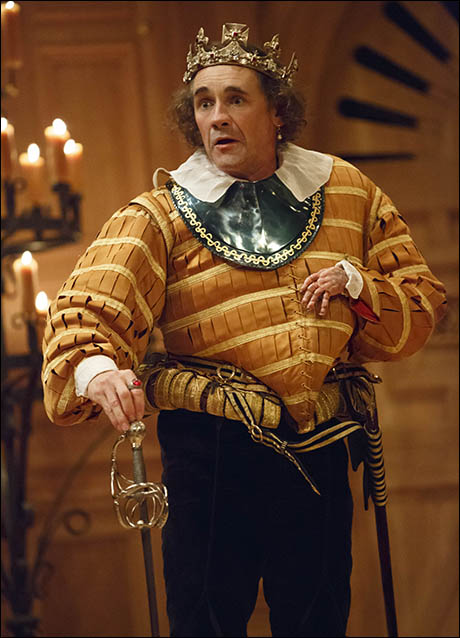
Have I mentioned Mark Rylance is amazing?
On January 2nd during snowstorm Hercules, I sat in the Belasco Theatre once more to see Twelfth Night‘s counterpart, Richard III – the other all-male Shakespeare production playing in rep until February 16th. For my Twelfth Night review and more details of Mark Rylance’s brilliance, click here.
What’s fantastic about Rylance’s Richard III is the way he draws in the audience, the way he shares his secrets with us. He confides in us from the opening moments, and we therefore root for him. We cheer him on throughout his bloody tirades, and we laugh with him as he manipulates everyone around him. We feel smarter and superior alongside him because we are “in the know.” We root for him until he no longer roots for himself. As Richard loses his swagger and falls into a kind of guilty despair (or insanity), we are left wondering what happened to the man who once strutted across the stage with such confidence and vigor. The other noticeable trait of this Richard is his sincerity with his fellow characters. In this brief New York Magazine interview, Rylance talks about not playing the obvious evil or falsehood that is largely associated with Richard but rather being as genuine as possible when in the company of others. Why make the other characters fools? Instead they can fully trust this man right up until he betrays them. What it comes down to is that you should go see anything Mark Rylance does. Anything.
That said, I will say that this production didn’t strike me the way Twelfth Night did. I found myself conscious of the staging/blocking in a way that never even crossed my mind during the ever-flowing Twelfth. And Richard may be five minutes shorter, but it felt longer. It drags more than I’d like, and I was so angry with myself for being bored. Note: this mostly happened whenever Rylance left the stage.
I also wanted much more from Lady Anne (the actor doubles as Sebastian). He felt very one-note to me, particular during his big scene with Richard. Now, this is an epically hard scene, and anyone who has ever played the role, whether in acting class or a full production, knows the challenges it brings. Anne is grieving at her father-in-law’s funeral when she is approached by Richard who killed both her father-in-law and her husband. Over the course of a five-minute scene, Dick convinces her to marry him (!). It’s insane to play. She has to journey through so many emotions to get to this point: hatred, disgust, betrayal, desperation, surrender, love, [insert additional acting choice here]. But this Anne yelled for most of the scene, and I was quite disappointed.
Samuel Barnett as Queen Elizabeth, on the other hand, once again impressed me. I very much enjoyed his Viola in Twelfth, and I loved seeing him play a statuesque queen this time around. There is an extremely challenging scene in Act II between Elizabeth and Richard, and it was so fantastic. The verbal swordplay and push and pull between these two actors was simply enticing. Elizabeth is an excellent match for Richard, perhaps the only real match to his wit, and Richard knows it. In their final exchange, Elizabeth stole the power back, and upon her exit, the audience cheered for her. And ohhh man, the look we got from Richard was unreal. He stared out at us with eyes of daggers, and it was clear we were no longer his friends. In fact, we may be next on his list.
Richard III
Written by William Shakespeare, Directed by Tim Carroll
Belasco Theatre through February 16th
Photo Credit: Joan Marcus
Pictured: Mark Rylance

 Becca on Broadway