
Side Show
Posted: December 10, 2014 Filed under: Broadway, Drama, Musical, Revival | Tags: aliceripley, broadway, broadwayreview, conjoinedtwins, daisy, daisyhilton, emilypadgett, emilyskinner, erindavie, freaks, iwillneverleaveyou, newyorktheatre, rosieodonnell, siamesetwins, sideshow, sideshowrevival, violet, violethilton, whowilllovemeasiam Leave a comment
The musical about conjoined twins brings double the thrills and double the heartbreak.
As I’ve tuned into the word of mouth and critical response this season, I’ve noticed that there are two camps of thought regarding the revival of Side Show. The buzz was nothing but positive early on, it got a great Times review, and many loved it. Meanwhile, on the other side of the spectrum, I’ve talked to people who couldn’t stand it – from the updated book to the direction of the entire piece. Whether or not this divisive response is a sign of good theatre is a conversation for another day. Instead, I’m here to tell you I’m in the first camp. I liked it! Quite a bit (watch a sneak peek here).
Side Show is based on real-life conjoined twins, Daisy and Violet Hilton, and their lives in the side show and vaudeville worlds of the 1930s. It had a brief Broadway run in 1997 starring Alice Ripley and Emily Skinner (watch them sing on Rosie O’Donnell’s old show here). The current revival is a revised version which started out at La Jolla Playhouse and then had a successful run at the Kennedy Center last summer. Now, I never saw the original, but I’m relatively familiar with the cast recording. I couldn’t sing the whole thing through from memory, but I recognize most of the tunes. All that to say, I’m not loyal to the original as I know some are. A friend of mine was very unhappy with all of the changes and found herself missing what it once was. About 60% or so has been revised: new songs, new scenes, the works.
The book is not without its flaws. The love stories get a little sloppy, but for some reason, it didn’t bother me. Things get melodramatic at times, which has never been a preference of mine, but it rides the edge nicely enough and never fully collapses into that style (like The Last Ship). A major flashback has been added to Act 1, filling in the girls’ backstory and how they ended up in a side show in Texas as the rightful property of the ringmaster. If there was one section that didn’t grab me as much as the rest, it was this scene. I understand the significance of including it, but the way it was told didn’t grab me. Harry Houdini stops by for a bit, and the action comes to a halt.
The two love interests, Terry and Buddy, who rescue the girls from the side show and make them vaudeville stars, kind of blend together. Basically, they’re underwritten. I suppose you could argue that it’s because they’re not the focus – we’re here for the twins and the twins alone. But come to think of it, the way the male romantic leads are written is similar to how many female roles are written in the canon. Not much to them, no real defining characteristics, there only to serve the purpose of the main (male) characters (Cosette, anyone?).
Flaws aside, the freaks are awesome in this. We begin with the side show and the charged opening number, “Come Look at the Freaks.” In the original, the choice was made to have everyone look “normal.” Kind of like in Violet – no make-up is used to display Violet’s terrible facial scar. It’s left up to the imagination and drives home the point of “they’re just like everyone else.” In the revival, there is nothing left to the imagination. The costumes and make-up are fantastic, and I think the message still comes through.
But let’s get to back to Daisy and Violet. Emily Padgett and Erin Davie are the heart of this musical. These two actresses are so in sync with each other that when the sisters are at odds, it’s all the more effective and challenging to watch them struggle (hear them talk about the experience of sharing a hip here). The Act One Finale, “Who Will Love Me As I Am,” is worth the price of admission in my book. Their voices together – oof, such power in their sound. Chills down my spine. The same goes for the Act 2 Finale, “I Will Never Leave You.” Both songs are show stoppers, combined with beautiful voices that lock in together perfectly.
Freak shows speaks to the inner part of us that wants to see people who look different or grotesque. I think it’s for the same reason drivers slow down on the highway to look at an accident. Ultimately, Side Show is a heart-breaking story about being different and longing for acceptance. Everyone can relate to feeling like a freak and wanting to be loved. It’s not a mistake when the spotlights on stage turn to shine on us for just a moment during the reprise of that taunting opening number. So come on, folks. Come look at the freaks.
Side Show
Book and Lyrics by Bill Russell, Music by Henry Krieger, Additional Book Material and Directed by Bill Condon
St. James Theatre, Closing January 4, 2015
Photo Credit: Joan Marcus
Pictured: Emily Padgett and Erin Davie
Les Misérables
Posted: December 3, 2014 Filed under: Musical, Revival, Drama, Broadway, Becca Doodle - Meh | Tags: review, hughjackman, newyorktheatre, newyorkreview, broadwayreview, lesmiserables, lesmiz, lesmizrevival, lesmiserablesrevival, anniversaryconcert, leasalonga, michaelball, russellcrowe, cosette, caissielevy, raminkarimloo, eponine, jeanvaljean, 24601, bringhimhome, fantine, lookdown 4 Comments
Well, it’s definitely better than the movie.
Okay readers, I’m warning you now – there will be plot spoilers in this review. So if for some reason you don’t know the plot of Les Misérables and wish to remain in the dark, you may have to skip this blog post. Don’t know Les Miz and want to? Watch the 10th Anniversary Concert; that’s the best way to get introduced. Not the Russell Crowe movie, not the Claire Danes movie, not the 25th Anniversary Concert – the 10th Anniversary Concert featuring the best of the best which aired on TV in 1996 (and which I then watched religiously for the next ten years).
Anyway, if it’s not clear from the above, I grew up with this musical. I saw the original three times on Broadway and twice in London and was honestly nervous to see this new production. The last revival I skipped because I heard it was a mess (despite Lea Salonga’s return). This one is far from a mess. I enjoyed quite a lot of it, but of course, I can’t help but have mixed feelings. Admittedly, this may be one of those cases of how can something ever beat the original. Regardless, here’s a look at where I stand on the newest Broadway revival of Les Misérables (click here for clips).
Things I Liked:
Caissie Levy can sang. Yes, she has more of a pop voice than we might be used to for Fantine, but it’s still nice to sit back and not have to worry that notes won’t be hit. Caissie can do those notes in her sleep.
Ramin Karimloo. Damn. I’d heard wonderful things but remained on edge for the first 20 minutes or so. Early on he had the tendency to be a little bit sharp, but that soon faded. This guy has a very powerful voice from his strong belt to his gorgeous falsetto (and apparently he’s never trained which is just crazy given his sound). Plus it doesn’t hurt that he’s a mighty fine specimen to look at.
Cosette. Now there’s a surprise. I have never liked Cosette. She’s underwritten and basically only there to serve the plot of the characters around her. Growing up however, my reasons weren’t as advanced (I just wanted to hate the pretty blonde who got the guy). But Samantha Hill’s voice floats up in those higher octaves in such a way that I actually didn’t mind the character as much. How I wish she had been in the movie instead of Amanda Seyfried.
Gavroche. Albeit I don’t know if I’ve ever not liked Gavroche. He’s always played by such a charming little kid. For his final scene, I am partial to the staging of the original production; the new one feels a little self-indulgent.
“Bring Him Home.” As I mentioned above, Ramin has a beautiful falsetto, and he does not disappoint on arguably one of the best songs/moments in the show. Everything in this epically enormous show gets dialed down for these few minutes, and you’re left with this one man singing his heartbreaking plea.
Things I Didn’t Like:
Marius. Sorry. I wasn’t into him. Andy Mientus is talented, but no one will ever top Michael Ball for me. Both the 12-year-old and 30-year-old in me will forever think his voice is the dreamiest.
Wow, my attention span is not what it used to be. No matter what other shows come along, Les Miz will have a place in my heart, but man, is that a long first act. It takes so long to get to the meat of the story. It’s possible I was super conscious of the pacing because I was there with Matt who was seeing it for the first time, and I was nervous that it might be too slow for his taste. I think he enjoyed it though!
The Thenardiers. I knowwww. I like both those actors, but the approach/direction didn’t feel right to me. They were dark, scary characters, and that’s fine! Still though, we crave that comic relief in this beast of a musical. We need laughs desperately, but “Master of the House” was just another tune passing by.
Things I’m Mixed About:
Projections are a big part of the set design, but I can’t comment on their use because I was sitting very far house right and could only see pieces of them. I wish I could have seen if they were effective or not.
I like Nikki M. James (Eponine) a lot. She was the heart of The Book of Mormon (for which she won a Tony), and I also got to see her at NYTW last year in Fetch Clay, Make Man. And her big note in “On My Own” was indeed chill-worthy, but I fear she might be miscast. I don’t think her singing voice matches the style of this music. It’s not a good fit to my ear.
For the most part I didn’t miss the turntable. I did my best to go in with an open mind knowing how different the staging would be without this iconic design. Sorry though – the barricades simply aren’t as impressive as they once were without them spinning around with Enjolras hanging off the back atop the red flag. That was the image of Les Miz. Now he’s in the same position…in a wheelbarrow.
Random Anecdote:
During the performance, I finally came to understand something that has been bothering me for as long as I can remember. It always dug at me that Fantine got to come back in the end in her beautiful white dress while Eponine was still stuck in her poor get-up. Why did Fantine get to be all ghostly and Eponine so dirty? But this time, for absolutely no reason at all, it clicked that the white dress is literally what Fantine dies in. It’s her hospital gown. Mystery solved! She wasn’t being favored by costume designers across the world! Is it just me? Am I the only weirdo who wondered about this?
Conclusion:
In closing, if you’re already a fan of the musical and feel the desire to see it again, I don’t think you’ll be disappointed by the newest revival. If you’ve never seen the show? This is a pretty reliable way to experience it live. Again though, you’re talking to the girl who was once a toddler bouncing around the house singing what I thought were the lyrics to the opening number: “Up down, up down, up down up down up down.”
I know, I’m a natural.
Les Misérables
Music by Claude-Michel Schöenberg, Book by Alan Boublil, Lyrics by Alain Boublil and Herbert Kretzmer, Adapted by Trevor Nunn and John Caird, Directed by Laurence Connor and James Powell
Imperial Theatre, Open-ended
Photo Credit: Matthew Murphy
Pictured: Ramin Karimloo
The Last Ship
Posted: November 5, 2014 Filed under: Becca Doodle - Sad, Broadway, Drama, Musical | Tags: billyelliot, broadway, kinkyboots, musical, review, sting, the police, thelastship 2 Comments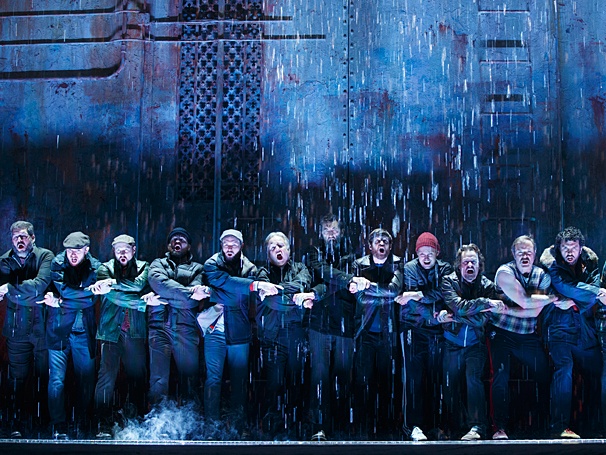
I think you’ll find that everything about Sting’s new musical The Last Ship feels very epic (click here for highlights). They certainly spared no expense with their advertising. The stakes are quite high for this small, English seafaring town, but unfortunately, it didn’t resonate with me. I think this may be because the book is trying to cover too much ground. It’s like an odd mix of Billy Elliot and Kinky Boots (or any other musical that takes places in the United Kingdom) – take out the miners and replace them with ship builders, trade out a son running away from his pop’s shoe business, and this time around, make it about, ya know, ships.
Let me see if I can describe the plot briefly (loosely based on Sting’s childhood). Gideon Fletcher is a young boy who is expected to build ships with the rest of the men in town, but he sees a different future for himself. He ditches his injured, abusive father and his ship-building roots to explore the world instead. He also leaves behind his girlfriend Meg. Fifteen years later he returns, and due to the economic depression, the shipyards have closed down, and his ex is engaged. Will Gideon return to his roots? Will he embrace the shipbuilders’ cause? Will he win back his girl?
Even though it seems like the show is pulling from all of the plots we’ve seen before, it is a new score. I think Sting has become one of the more successful pop/rock stars to shift into the musical theatre genre. Like Cyndi Lauper (Tony-winning composer of Kinky Boots), he’s got his own thing going on and has written a lush, dark score with an actual arc (something Spiderman could have used). Several melodies were very catchy, although the songs that were stuck in my head afterward may have been due to the fact that they were reprised approximately 13 million times.
Alongside the solid score is a very cool set design and a strong cast. Rachel Tucker as Meg has a great voice and presence. Fred Applegate (her father and the town preacher) is reliable as always; he brings some of the much-needed humor to the piece. I like Michael Esper (Gideon), but it also took me till about halfway through the first act to start understanding whatever he was singing about. I could not get my ears to wrap around his accent. Collin Kelly-Sordelet brings a tough innocence to his performance as Tom Dawson, Meg’s 15-year-old son (hmmm, I WONDER who the father could be?).
Here are some of the reasons I had trouble with the story. One of the biggest plot points is that these men aren’t going to be allowed to build ships anymore. So they start a revolution and resolve to build one anyway – one last, this-is-gonna-be-the-best-ship-ever – but for what purpose I don’t know; it’s never made clear. Then, the protagonist’s big shift in the end of Act I which ultimately builds to the finale, didn’t do anything for me. His decision to all of a sudden go from completely indifferent to caring passionately about a cause came out of nowhere. Dramatically you need more of a believable transition to go along for that ride. There simply wasn’t time to spend on his character shift, much less the supporting characters. Most came across as one-dimensional, there only to serve one purpose. The love triangle also drove me crazy. It’s like it only exists because it’s expected in a musical. This guy returns after 15 years and starts making moves on the woman he left behind, leaving her conflicted as to whether she should stay with her long-term, kind, committed, hot (thank you, Aaron Lazar) boyfriend. Are we really supposed to be rooting for Gideon to win her back?
The book is trying to cover so many different things that it leaves us with majorly underdeveloped characters. They remain archetypes: the rebel, the scorned woman, the adamant ship-building guys, the wide-eyed boy, the sarcastic preacher who drinks, the dedicated boyfriend who is also apparently the guy in charge of keeping the shipyards closed down…I didn’t really understand that part.
Despite a talented cast, haunting score, and exciting design, The Last Ship’s story will unfortunately leave you out to sea.
The Last Ship
Music by Sting, Book by John Logan and Brian Yorkey, Directed by Joe Mantello
Neil Simon Theatre, Closing January 24th, 2015
Photo Credit: Joan Marcus
Pictured: Fred Applegate, Jimmy Nail, and the cast of The Last Ship
The Real Thing
Posted: October 22, 2014 Filed under: Becca Doodle - Sad, Broadway, Drama, Play, Revival | Tags: broadway, cynthianixon, ewanmcgregor, itsaboutyou, maggiegyllenhaal, moulinrouge, review, roundabout, samgold, therealthing, tomstoppard Leave a comment
If you went to high school with me, then you know I fell in love with Ewan McGregor when I was 17-years-old, saw “Moulin Rouge” for the first time, and my young mind exploded. You also know that I had a Seth Green phase earlier in high school, but let’s move past that for the moment. After I proceeded to watch as many of Ewan’s films as I could the following year, I eagerly awaited the moment to see him in a live play (since I tried and subsequently failed to see him in Guys and Dolls when I was studying abroad in England). So yes, I admit, Ewan was the primary reason I wanted to attend the newest revival of Tom Stoppard’s The Real Thing.
Henry (Ewan McGregor) is a playwright. His current play is about a woman who cheats on her husband, starring his wife Charlotte (Cynthia Nixon) and an actor named Max (Josh Hamilton). In real life, Max is married to Annie (Maggie Gyllenhaal). When we learn that Henry and Annie are actually having an affair, art begins to imitate life. Or is it the other way around?
Sadly, this production left me wanting in many ways. I wasn’t invested in these characters, emotionally or intellectually. They don’t need to be sympathetic (which they aren’t) for me to be invested, but I still have to want to go on a journey with them. Instead I felt left behind. This was in part due to the story itself being confusing at times (intentionally), and it can be hard to follow because the language is so dense. But that aside, I couldn’t connect to the style itself. It was very presentational and plotted out. Rather than discovering on the line, all of the words seemed planned. If a character had a big speech, it was performed like he or she had memorized it and had reached the appropriate time to recite it. It did not feel spontaneous.
Matt and I were discussing that maybe this was because of the slightly heightened, highly intellectual language, but on the other hand, Shakespeare is heightened and poetic. Even if you don’t catch all of the metaphors, subtext, and meanings in the first hear-through, you are still with the characters. You’re discovering things together, in the moment, no matter the density of the words. For example, when I saw the revival of Stoppard’s Arcadia a few years back, I went in blind, and while I was desperately confused at times (lots of math talk in that play), I still felt like I was there with the characters, going through something with them, trying to figure it out together.
The Real Thing won a Tony Award for Best Play in 1982 and Best Revival of a Play in 2000. It took home the Drama Desk, and the leads won Tony Awards in both productions. I mean, it makes sense! Stoppard is one of our most popular playwrights, known for his intense, philosophical, beautiful dialogue and topics. And I love all four of these actors in their other works. I think the root may be a direction/style choice. I’m curious what the previous productions did differently that made them so successful.
This play is about love, marriage, and in/fidelity. It’s about the feelings that are left unsaid, acting the opposite, playing it cool. We find out rather quickly that the first scene is a performance, a play within a play, but come the second scene in “reality,” it still feels like a performance. This might have been the point, as it partly represents the lack of honesty being shared among the characters, but then again, there needs to be a contrast. There are only a couple of moments with that kind of truth sprinkled in (Ewan has a touching moment alone onstage in the second act that I appreciated). I don’t mean that the characters need to show this truth to each other, but the vulnerability could be shared with us. Someone should be honest with the audience and make that connection, if only for a moment, because we want, we need the real thing.
The Real Thing
Written by Tom Stoppard, Directed by Sam Gold
American Airlines Theatre, Closing January 4, 2015
Photo Credit: Joan Marcus
Pictured: Maggie Gyllenhaal and Ewan McGregor
Scenes From a Marriage
Posted: October 15, 2014 Filed under: Becca Doodle - Happy, Drama, Off-Broadway, Play | Tags: heddagabler, ingmarbergman, ivovanhove, newyorktheatreworkshop, nytw, scenesfromamarriage, susannahflood Leave a comment
What a fascinating, innovative, different type of play experience. Of course, I’d expect no less from an Ivo van Hove production. The Flemish director often revisits New York Theatre Workshop to reinvent plays as we’ve come to know them. When I saw Hedda Gabler starring Elizabeth Marvel in 2004, it completely changed my view of theatre. He’s also directed A Streetcar Named Desire, The Misanthrope, and The Little Foxes there. Ivo strips plays down to the characters’ most primitive instincts and then heightens them all over again, leaving you with a very different approach than the original you had come to expect. Scenes From a Marriage is his newest project, based on the 1973 Ingmar Bergman TV mini-series.
As the title hints, we bear witness to different scenes from the same marriage. During Act I, the stage is split into three separate sections. When you arrive for the show, you’re given a colored wristband determining which room you enter first. Within the three rooms are three different sets of actors playing the same couple, Johan and Marianne, at different stages of their marriage, from its more promising beginnings to later struggles. In the first room, timeline-wise, are Alex Hurt and Susannah Flood, 10 years into their marriage. A half hour later you move into the next room to see Dallas Roberts and Roslyn Ruff playing the same couple later on, and lastly are Arliss Howard and Tina Benko working through the remains at the end. Meanwhile, the scene(s) you already watched are replaying beyond the thin walls. You can hear the fights, ones you’re familiar with and ones you have yet to hear – the echoes of past and future battles that resonate throughout the story.
The majority of the second act is absolutely thrilling. The theatre is transformed into one large open space, and as the six actors enter (together this time), the audience begins to prep itself for the roller coaster ride they expect is coming. The scene begins as the characters alternate lines, and soon the three pairs begin doing the same scene at once, overlapping and moving about the entire space. Three different interpretations, three different deliveries, all happening at the same time. It requires active listening from both the audience and the actors. I sat on the edge of my seat, eyes darting back and forth, catching key phrases here and there, and latching on for dear life. Hearing the same scene layered on top of itself made the words more vibrant and charged.
Despite this intense engagement, I did struggle with the latter half of Act II as my attention wavered (there were dips in Act I as well). I should note here that the play is three and a half hours long (including a 30-minute intermission). It doesn’t feel that long, but certain scenes weren’t as engrossing for me. Although this may have been because they were such a stark contrast to the times when there was so much going on. It was an odd thing bouncing back and forth between being overly engaged to not totally present. The play is well acted, but I was most partial to Susannah Flood’s performance as Marianne 1. She is moving, spontaneous, and a joy to watch.
To sum up, if you’re interested in seeing a piece of theatre that will challenge you to listen and work your brain, I do recommend Scenes From a Marriage. If nothing else, it’s always a good idea to be introduced to Ivo van Hove’s approach to theatre.
Scenes From a Marriage
Written by Ingmar Bergman, English Version by Emily Mann, Directed by Ivo van Hove
New York Theatre Workshop, Closing October 26th
Photo Credit: Sara Krulwich
Pictured: Tina Benko, Dallas Roberts, Roslyn Ruff, Alex Hurt, Arliss Howard, and Susannah Flood

 Becca on Broadway