
Julius Caesar
Posted: November 8, 2013 Filed under: Drama, Off-Broadway, Play, Shakespeare | Tags: allwomen, juliuscaesar, review, shakespeare, stanns 1 Comment
I was very excited to see the all-female production of Julius Caesar at St. Ann’s Warehouse, directed by Phyllida Lloyd and brought over from the Donmar Warehouse (a fantastic theatre in London). I know that sentence sounds like a set up for the show being disappointing. And it wasn’t, but at the same time, I also wasn’t as blown away as I’d hoped to be. Perhaps I went in with expectations too high. This happens to me more often than I’d like.
But after thinking it over since this particular Halloween outing last Thursday, I think the underlying issue is that I am simply not a big fan of the play. Is that sacrilegious to say, Shakespeare fan that I am? Caesar has never done much for me as a reader or audience member. I’ve been trying to figure out why, and I keep coming up relatively empty. Is it because I have trouble relating to the story? Do I not sympathize with any of the characters? Unclear.
Given that the story bores me, this production did a pretty decent job of holding my attention. First off, it is set in an all-female prison #orangeisthenewblack. The audience is escorted by extremely stern guards (ushers) into a sterile prison of pipes and scaffolding and lectured about how to behave before being led to our seats. I love this kind of thing – immediately transporting us into a new environment and setting the scene before we even take our seats.
These (very talented) women tell the iconic story that we know so well, straying only occasionally from the classical text for a handful of contemporary references (e.g. the prophecy of Caesar’s demise is a Libra horoscope). They have a fantastic grasp of the language, and they also stick to all of the original pronouns, referring to each other as men. This is typically a very male-heavy show, but it should be noted that the power or strength of that overwhelming testosterone is not lost with this cast.
Lloyd plays with the location and convention of the prison throughout but not as much as I would have liked. These were the moments that particularly grabbed me and made me sit forward in my seat – the recognition and awareness of the surrounding reality, like in Alan Cumming’s Macbeth. If anything, this switched things up from the standard plot. Whether or not the play does anything for me though, the cast is fantastic, and you get the feeling when the show ends that there is still more story to be told.
Fun side note: I should mention that at one point during the show, during the big senate scene I believe, all of a sudden I noticed someone sitting upstage in one of the chairs. After a little while, I thought to myself, is that person a part of the show? That doesn’t look like a woman. Yup, that’s a man…holding a program – an audience member who somehow managed to take a seat within the set and then sat there for close to 15 minutes, from Caesar’s death scene (spoiler alert) up through Mark Antony’s huge monologue. He was practically one of the conspirators. Hi-larious.
Julius Caesar
Written by William Shakespeare, Directed by Phyllida Lloyd
St. Ann’s Warehouse through November 9th
Photo Credit: Helen Maybanks
Pictured: Harriet Walter
The Glass Menagerie
Posted: November 4, 2013 Filed under: Broadway, Drama, Play, Revival | Tags: cherryjones, gentlemancaller, glassmenagerie, review, revival, tennessee, williams, zacharyquinto 2 Comments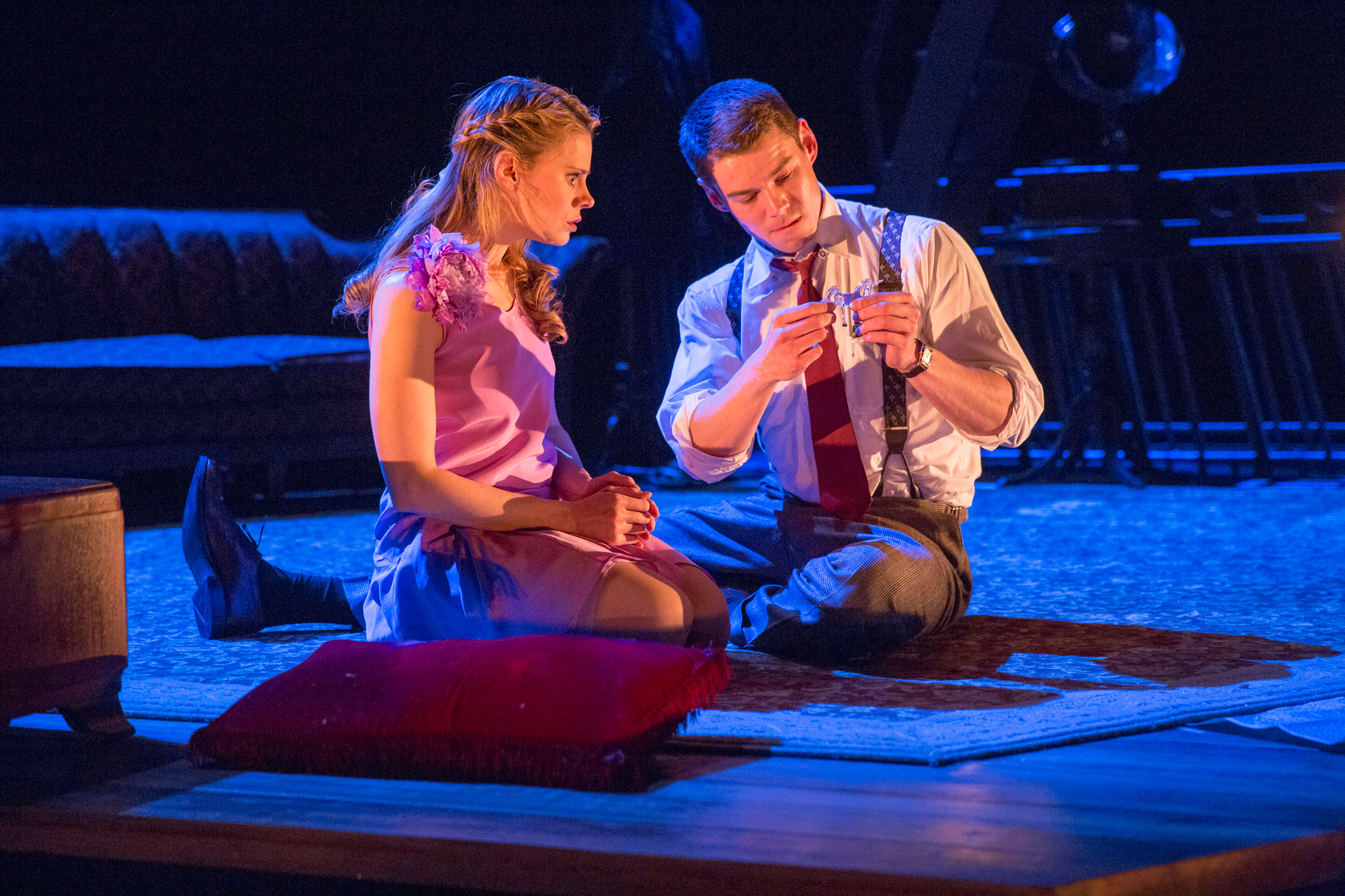
If you’ve spoken to anyone about the newest production of The Glass Menagerie on Broadway, then you already know that not one person has a bad thing to say about it. As a result, I feel like this review might end up being a little bit gratuitous – simply one more positive response to add to the mix. But if you’ll indulge me, it is a beautiful revival, literally and figuratively.
In its natural essence, as Tom states in the opening lines, Menagerie is a memory play, but I don’t think I’ve ever before seen the “memory” factor as effectively portrayed as it is in this production. We revisit Tom’s past by his side and see with his eyes what continues to haunt him to this day. Together we stumble back into his memories. Through stage magic and stylized movement, it feels almost like a dream. Which I’ve come to learn is exactly how this play should feel. This is one of those productions (similar to David Cromer’s production of Our Town at Barrow Street) where you leave thinking, “Oh. That’s how that play is supposed to be done.”
The set and lighting design alone create the space for Tom’s memories to take form. Much of the stage is dark with only certain pieces of scenery highlighted, patchy in the dark corners of his mind. There’s a fire escape that leads to nowhere and a home floating on a reflective surface. We too float in Tom’s memory. The memories are also physicalized through movement, repeated gestures, the appearance and disappearance of characters, private moments as characters loom over the edge of the living room.
Despite the beauty of the design elements, we know that most people see this play for the acting. These are four iconic roles, and across the board, these actors will not let you down. You might think you’re only going for Cherry Jones (Amanda) or to see Zachary Quinto (Tom), but Celia Keenan-Bolger (Laura) and Brian J. Smith (Gentleman Caller) are just as excellent. Quinto is enticing in his Broadway debut. His southern drawl draws everyone in from the opening moments. Keenan-Bolger gives a beautifully subtle performance as the extremely shy Laura. In the first act, she practically blends in with the scenery.
Now my experience of Amanda has always been the ultimate overbearing mother. She is a domineering, angry woman who feels burdened with her children and the abandonment of her husband. But Cherry Jones has changed my view. True, this woman is can be a lot to deal with day after day, but she cares deeply about her children. She wants the best for them and is desperately trying to lead them to “happiness and success.”
The brilliance of this play and John Tiffany’s direction is that the audience reaches intermission craving the arrival of the Gentleman Caller just as much as the Wingfields. We crave the new energy, a new character to shake up the status quo. Maybe he really will be the answer we’ve all been looking for.
Which brings me to the Gentleman Caller scene. I swear, sometimes I think that scene is all Tennessee Williams needed to write. It’s so real and beautiful and absolutely heart-breaking. This particular performance is so incredibly private and fragile; it feels like it’s just you, Jim, and Laura sitting together on the floor for hours. It was also a nice change to see a new interpretation of Jim. He isn’t portrayed as the perfect cut-out of a man. He has struggles of his own – with his work, his future, and his confidence. He and Laura aren’t so different after all. It’s astounding to me that in such a short amount of time, the entire audience can feel the same kind of crushing disappointment that Amanda feels and the guilt that plagues Tom.
The Glass Menagerie is going to be the piece that people talk about all season long. This production made me see this classic play in a completely new light. That’s the whole point of a revival, right?
The Glass Menagerie
Written by Tennessee Williams, Directed by John Tiffany
Booth Theatre through February 23rd
Photo Credit: Michael J. Lutch
Pictured: Celia Keenan-Bolger and Brian J. Smith
Domesticated
Posted: November 1, 2013 Filed under: Off-Broadway, Play | Tags: brucenorris, domesticated, gender, goldblum, linctix, review Leave a comment
There are few things I enjoy as much as seeing a good new play and then talking about it the entire commute home. And I don’t mean just talking about what we liked or didn’t like, or the design, or even the acting. I mean, talking about the play – diving deeper into the ideas it touched on. I love when the conversation continues after the lights come back up.
The playwright Bruce Norris wowed me (plus a few Tony voters) with Clybourne Park a couple seasons ago, so when I heard he had a new play at the Mitzi E. Newhouse up at Lincoln Center, I bee-lined for Linctix to buy myself a ticket. Not to mention it’s directed by Anna D. Shapiro (August: Osage County) and starring Jeff Goldblum and Laurie Metcalf. It’s called Domesticated, and I do recommend checking it out.
Now I don’t want to give much away because I think the play raises some very interesting questions, and they’ll sound a whole lot smarter in the context of the play than me trying to paraphrase them here. I will say that it is a piece about gender, politics, (gender politics?), betrayal, morality, and the concept of men versus women, in all respects really.
A politician, Bill (Goldblum), is introduced. He is at a press conference confessing to a crime, resigning from his post, and his wife Judy (Metcalf) is at his side. The Good Wife, anyone? Bill is surrounded by women in his life. After that first speech of his, he is primarily silent for the remainder of the first act. It’s fantastic to watch. He is talked over and practically trampled by these women (his wife, his daughter, his lawyer, etc.). But boy does he start to talk in Act 2.
What’s incredibly impressive about the “men versus women” conversation that Norris brings up is that in one moment I found myself fully on Judy’s side, but at the same time, I was eagerly awaiting Bill’s rebuttal. This (male) playwright manages to represent both sides/genders quite effectively. Bill can be incredibly misogynistic and sexist at times, but then in the next moment, I actually find myself sympathizing with his character. But then he opens his mouth again. It helps that Goldblum’s trademark way of speaking keeps things lighter and more casual than they might typically be.
As the plot unfolds and we watch Bill’s fall from power, there are some nice surprises along the way, great laughs, smooth set changes, clever plays on media and marriage, and a really strong ensemble to tell the story. Overall, I would say that if you enjoy going to the theatre to think, I highly recommend Domesticated. And after that? I would love to hear your thoughts.
Domesticated
Written by Bruce Norris, Directed by Anna D. Shapiro
Lincoln Center Theater through January 5th
Photo Credit: Joan Marcus
Pictured: Jeff Goldblum
So You Want to See Sleep No More?
Posted: July 24, 2013 Filed under: Off-Broadway, Play, Shakespeare, Tips | Tags: macbeth, masks, mckittrick, sleepnomore, tips Leave a comment
Odds are by this point you’ve heard about Sleep No More. It’s been quite the sensation in NYC. What started as a super limited engagement over two years ago is still running to sold-out houses. I’m here to tell you to catch it before it’s gone. As far as interactive, theatrical experiences go, this is top-notch and one of the coolest nights at the theatre I’ve ever had. If you choose to go, it’s good to be prepared so below is my list of tips to fully enjoy the evening.
But first, a few words on what Sleep No More actually is. It’s a Punchdrunk production – a British company known for their interactive, site-specific theatre. A warehouse in the meat-packing district has been turned into this 1920s dark, creepy hotel called the McKittrick. There are five floors and countless rooms. The audience moves through the space freely wearing white masks. Meanwhile, the performers also run around from room to room (without masks so you know who to watch). It’s primarily a dance piece, and through movement, they tell the story of Macbeth. Very little is spoken, it’s super avant-garde, and like nothing you’ve ever seen before.
Okay, my suggestions. Go.
-Review Macbeth. If you don’t know the play, read it first or get an idea of the synopsis and characters. This will be helpful when you catch a scene out of context, but at the same time, don’t worry if you don’t know what’s going on or who someone is. Just enjoy the performances!
-Wear comfortable shoes. And dress comfortably, not too heavy. It’s hot in there.
-Check everything when you arrive. Really. Don’t carry a bag, phone, purse, loose change, etc. You don’t want to worry about that stuff when you’re running around in the space.
-Follow your instincts. If you’re bored or want to check something else out, go somewhere else. That’s why the show is brilliant. You can do whatever you want; you create your own unique experience. No two people have the same night at the theatre.
-On that note, if you go with someone, I highly encourage you to split up. This way you can truly follow your gut and do what you want. You’ll likely run into each other throughout the evening anyway.
-The whole show loops three times except for the finale so you very well may see something twice. If you happen upon a scene you’ve already seen, you don’t necessarily have to immediately ditch. You could follow a different actor at the end of that segment.
-It might be a while before you find an actor when you first enter the space. My first time it took me 40 minutes, and my second time I practically ran into one right when I walked in. As soon as you see someone without a mask, follow! Run if you’re up for it!
-I know there are a lot of cool rooms, props, and keys. Enjoy this and feel free to explore, but don’t get obsessed. I know someone who sat in a room and waited for ages, sure that something would eventually happen, and another friend who found a key and spent the entire show trying to find what it opened. The details are fun and you should definitely look around, but don’t dedicate your evening to them.
-Hydrate! I suggest checking a water bottle with your stuff so you have it to drink afterward.
-Wear a watch so you can head to the ballroom at the appropriate time for the finale. If it’s a 7pm show, head over around quarter to 10pm. This is the one thing you want to plan on. Get as close to the long table as possible.
Above all, I would say be ready to adapt. I wouldn’t go in with a plan; it’ll likely just backfire due to crowds or getting lost and you’ll end up being disappointed. I’ve talked to a lot of folks who have been worried that they’re going to miss something. Honestly, that’s the nature of the show. You are going to miss things; you can only be in one room at a time. But who knows what you’ll get to see?
With or without these tips, you’re going to have an excellent, one-of-a-kind evening. Tickets are expensive, but man, is it worth it.
Sleep No More
A Punchdrunk Production, Directed by Felix Barrett and Maxine Doyle
McKittrick Hotel through February 16th
Photo Credit: Yaniv Schulman
Pictured: Matthew Oaks
Reasons to Be Happy
Posted: June 27, 2013 Filed under: Off-Broadway, Play | Tags: mcc, reasonstobehappy, review Leave a comment
I was quite looking forward to seeing this Off-Broadway play last night. I know many people have a complicated relationship with Neil LaBute, but I tend to like his work. Several of his plays have struck a chord with me, particularly a production of This Is How It Goes that I saw in London back in 2005. His most recent play on Broadway, reasons to be pretty, which starred Marin Ireland and Thomas Sadoski, was very well done. Yes, it’s a similar title for a reason (no pun intended). Reasons to Be Happy is as close to a sequel as you can get in the theatre. We revisit the same four characters (played by four new actors), in the same town, three years later.
What’s immediately clear from the first moments is that these people haven’t changed. They still haven’t grown up and are just as flawed as ever. Now, this may be realistic, and even refreshing to see, but it’s also not all that interesting, or theatrical for that matter. I’ve already seen this story. I don’t see the need to witness the same struggles rehashed by the same characters.
But first, some background. In pretty, the play opens with Greg’s girlfriend Steph screaming at him. It’s an enormously foul-mouthed monologue, telling him off because she found out he told his friend that her face was “okay.” Their four-year relationship promptly begins to fall to pieces while their friends, Carly and Kent, have problems of their own (they’re married, Kent is cheating, she’s pregnant, and so on and so forth). Cut to the opening of Happy, again in the middle of a fight because Steph, now married to the unseen Tim, has found out that Greg is dating Carly…who is raising her 3-year-old daughter alone and still works at the same place as Kent.
Sheesh. Okay, now that all that soap opera set-up is done, we can move on. I was super engaged in the first scene. It’s exciting when a show opens in the middle of a fight! It starts off with a bang, and you have to work to catch up. I love Josh Hamilton (Greg), and it was great to see Jenna Fischer (Steph) play someone so unlike Pam. After making a scene in front of Trader Joe’s, the plot thickens: she wants him back and he has to choose between her and Carly. Of course, other things hang in the balance making the decision more difficult, but I found myself not caring about his predicament. And I sat there basically trying to figure out why.
The core issue simply might be that these characters aren’t very likeable. Greg is pretty much a wishy-washy ass. He’s the master of non-confrontation, and he ends up lying his way through most of his interactions in order to avoid conflict. He is our protagonist, and I was simply not rooting for him anymore. In pretty, I was eager to see him climb his way out of the grave he had dug, but this time around, I didn’t want to see him succeed.
Also, can I go on a mini-tangent for a second? I’m a little tired of the homophobic language LaBute adopts for his “typical douche bags.” Dropping the words gay and fag right and left is a common occurrence in his plays; it’s just how the dumb jocks talk. But I think it’s unnecessary at this point. I get that there are people who still talk like that, but last night it just felt uncomfortable and out of place. I mean, we’re watching this play on Christopher Street while there is a gay pride rally outside celebrating the momentous step forward by the Supreme Court’s decisions on DOMA and Prop 8. I just think LaBute needs a new gimmick for that archetype. Okay, I’m done.
The play is well acted (the cast also includes Leslie Bibb and Fred Weller). My guess is that people who have no prior knowledge of these characters would very likely enjoy this production! I would have liked to see these four go through a new set of circumstances together. I just didn’t need to see reasons to be pretty again.
Reasons to be Happy
Written and Directed by Neil LaBute
Lucille Lortel Theater
Photo Credit: Joan Marcus
Pictured: Josh Hamilton and Jenna Fischer

 Becca on Broadway