
Dinner with Friends
Posted: February 28, 2014 Filed under: Drama, Off-Broadway, Play, Revival | Tags: dinnerwithfriends, donaldmargulies, jeremyshamos, margulies, review, roundabout 2 Comments
I love the playwright Donald Margulies. I love his dialogue, his style of writing, his sense of humor, and what he has to say about relationships, marriage, and friendship. His plays consistently hit me in the gut and make me think (Dinner with Friends, Time Stands Still, Collected Stories). But this production of Dinner with Friends made the material feel stagnant. I was very excited to see it and took my dad for his birthday, but it simply didn’t sit right with either of us.
The play follows two married couples and the changes that occur within their friendship when one of the couples announces they’re getting a divorce. I think it was primarily the direction that I didn’t see eye to eye with, but occasionally it may have been the acting as well. I typically very much enjoy Pam McKinnon’s directing (Clybourne Park, Who’s Afraid of Virginia Woolf?), but this fell flat for me. Not all of it by any means! I don’t want to give the impression that the production is bad. Certain parts I was very much involved in and couldn’t tear my eyes away, but then on a dime, I’d fall out of it. And as my dad pointed out, the humor wasn’t landing as much as it typically does in a Margulies play. Yes, it may be a tragic story, but there is, more often than not, comedy found within the tragedy.
Margulies is all about the scene work. It’s about the conversation, the witty, often biting, back-and-forth between characters. It’s day after day of conversation after conversation, and I eat it up. There is a major sense of realism with his writing, meaning when something feels out of place or false I’m taken out of it. If there is random blocking or awkward staging, if we stray from the “reality” for even a moment, I’m gone and have to work my way back. Sometimes it’s an odd delivery of a line or facing out instead of directing one’s words TO the other character. The second scene, for example, was problematic (as Charles Isherwood also states in the Times). The couple getting a divorce is having a very tense conversation that snowballs quickly into an intense argument. They are standing on opposite ends of the stage, cheating out, and talking at each other. Instead of feeling their pain, I was just thinking about how obviously they were cheating out. Quite often the blocking (or lack thereof) didn’t serve the actors. Even in the top of Act II when we open on a flashback 12 years earlier, the new set doesn’t do anything to help the scene. The actors are practically stuck in a line with limited space to move and play.
Jeremy Shamos, though. Man, is he good. This isn’t news (Clybourne Park, The Assembled Parties), but honestly, I could watch him do the whole play by himself. In the last scene, although it doesn’t quite redeem some of the weaker parts of the show, he instantly draws you in – right along with what his character is going through. His work is always so natural and effortless. The moments we get to spend with him bring the sad humor, depth, and punch in the gut I’m looking for when I’m in the mood for some Margulies.
Dinner with Friends
Written by Donald Margulies, Directed by Pam McKinnon
The Laura Pels Theatre through April 13th
Photo Credit: Jeremy Daniel
Pictured: Marin Hinkle and Jeremy Shamos
No Man’s Land
Posted: January 15, 2014 Filed under: Broadway, Comedy, Drama, Play, Revival | Tags: beckett, captainpicard, cort, engaged, godot, haroldpinter, ianmckellen, nomansland, patrickstewart, pinter, pinteresque, rep, review, samuelbeckett, waitingforgodot, youshallnotpass Leave a comment
I try so hard with Harold Pinter. I loved studying him in school. I even wrote a “Pinteresque” one-act with my friend Sandy entitled The Bells for a class during senior year of high school (for a brief excerpt, see the end of this review). Pinter’s writing can be so funny and thought-provoking, but when I see productions, I don’t end up being as riveted as I had hoped. I understand his significance and place in theatre history, but the plays simply don’t do anything for my soul. I want to stress that this is not to say No Man’s Land is not a good production; it’s just not my taste. So please don’t let this review stop you from going to see it. The show has received rave reviews and rightly so. I think I’m just realizing that while I may appreciate Pinter, I don’t necessarily enjoy his plays.
No Man’s Land might be the one to see though, especially when you’ve got A-list actors like Ian McKellen and Sir Patrick Stewart sharing the stage. It’s pretty grand being in the same room with both of them. Their presence alone is effective. They can hold a room with no words at all, and the cast is nicely rounded out by the younger fellows, Billy Crudup and Shuler Hensley. But don’t expect to go, sit back, and let them do all the work – Pinter expects you to pay attention. There is so much subtext and double-meaning and subtlety to sift through in his language it can take up to 15 seconds to catch on to the fact that a joke was just made.
This production is currently playing at the Cort Theatre in rep with Samuel Beckett’s Waiting for Godot. The similarities between the plays are clear: there is a sense of isolation for these characters and feeling trapped in both pieces. And the audience must work hard to understand the given circumstances. In No Man’s Land, we wonder what these men’s relationships are. Where are we? Why are we here? What should we take away from this experience? Whatever you do, don’t expect clear answers. You might finish Act One with an idea about who these folks are and their relationship to each other, but then Act Two turns any semblance of an idea you once had on its head. All of a sudden you have to adapt to entirely new information. And then, for me anyway, the “plot” basically falls off any kind of trackable course. You can try your best to make it make sense, searching for linear storylines and/or relationships, but I think you’ll just end up more confused. As director Sean Mathias explains, “Pinter isn’t saying what he necessarily means or meaning what you might like to believe. Like Godot, No Man’s Land is a game of memory, of time elapsed and elapsing; dealing with things abstracted, ideas and not realities.”
If you’re interested in seeing iconic actors and an iconic playwright then definitely check it out, or if you’d prefer, you can wait for Godot with me. Personally, I am more excited for Beckett’s classic, although my younger self would never have believed that statement, given that the first time I saw the play I was so angry with how much time I’d wasted waiting for this jack-ass Godot. But – that was before I studied the play with the brilliant Dr. Coppa at Muhlenberg College. You know, perhaps that’s what I need to fully understand and enjoy Pinter’s work, too. I just need to go back to class.
Update 4/26/16: This production is transferring to London this summer. You can find more information here.
No Man’s Land
Written by Harold Pinter, Directed by Sean Mathias
Cort Theatre through March 30th
Photo Credit: Joan Marcus
Pictured: Ian McKellen and Patrick Stewart
And now, what you’ve all been waiting for…an (incredibly brief) excerpt from The Bells:
Cecil: Did you change your hair?
Raine: What?
Cecil: Your hair- is it different?
Raine: No.
Cecil: You seem different. Are you sure?
Raine: Yes…I did…nothing to my hair.
Pause.
Richard III
Posted: January 10, 2014 Filed under: Broadway, Comedy, Drama, Revival, Shakespeare | Tags: allmale, belasco, markrylance, mykingdomforahorse, rep, review, richardiii, samuelbarnett, shakespeare, twelfthnight Leave a comment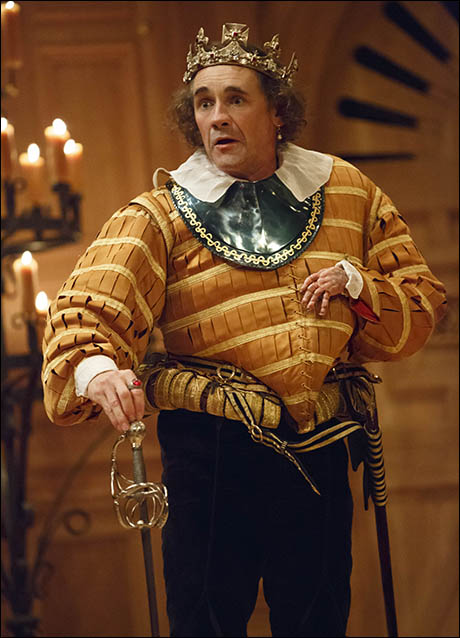
Have I mentioned Mark Rylance is amazing?
On January 2nd during snowstorm Hercules, I sat in the Belasco Theatre once more to see Twelfth Night‘s counterpart, Richard III – the other all-male Shakespeare production playing in rep until February 16th. For my Twelfth Night review and more details of Mark Rylance’s brilliance, click here.
What’s fantastic about Rylance’s Richard III is the way he draws in the audience, the way he shares his secrets with us. He confides in us from the opening moments, and we therefore root for him. We cheer him on throughout his bloody tirades, and we laugh with him as he manipulates everyone around him. We feel smarter and superior alongside him because we are “in the know.” We root for him until he no longer roots for himself. As Richard loses his swagger and falls into a kind of guilty despair (or insanity), we are left wondering what happened to the man who once strutted across the stage with such confidence and vigor. The other noticeable trait of this Richard is his sincerity with his fellow characters. In this brief New York Magazine interview, Rylance talks about not playing the obvious evil or falsehood that is largely associated with Richard but rather being as genuine as possible when in the company of others. Why make the other characters fools? Instead they can fully trust this man right up until he betrays them. What it comes down to is that you should go see anything Mark Rylance does. Anything.
That said, I will say that this production didn’t strike me the way Twelfth Night did. I found myself conscious of the staging/blocking in a way that never even crossed my mind during the ever-flowing Twelfth. And Richard may be five minutes shorter, but it felt longer. It drags more than I’d like, and I was so angry with myself for being bored. Note: this mostly happened whenever Rylance left the stage.
I also wanted much more from Lady Anne (the actor doubles as Sebastian). He felt very one-note to me, particular during his big scene with Richard. Now, this is an epically hard scene, and anyone who has ever played the role, whether in acting class or a full production, knows the challenges it brings. Anne is grieving at her father-in-law’s funeral when she is approached by Richard who killed both her father-in-law and her husband. Over the course of a five-minute scene, Dick convinces her to marry him (!). It’s insane to play. She has to journey through so many emotions to get to this point: hatred, disgust, betrayal, desperation, surrender, love, [insert additional acting choice here]. But this Anne yelled for most of the scene, and I was quite disappointed.
Samuel Barnett as Queen Elizabeth, on the other hand, once again impressed me. I very much enjoyed his Viola in Twelfth, and I loved seeing him play a statuesque queen this time around. There is an extremely challenging scene in Act II between Elizabeth and Richard, and it was so fantastic. The verbal swordplay and push and pull between these two actors was simply enticing. Elizabeth is an excellent match for Richard, perhaps the only real match to his wit, and Richard knows it. In their final exchange, Elizabeth stole the power back, and upon her exit, the audience cheered for her. And ohhh man, the look we got from Richard was unreal. He stared out at us with eyes of daggers, and it was clear we were no longer his friends. In fact, we may be next on his list.
Richard III
Written by William Shakespeare, Directed by Tim Carroll
Belasco Theatre through February 16th
Photo Credit: Joan Marcus
Pictured: Mark Rylance
Twelfth Night
Posted: December 11, 2013 Filed under: Broadway, Comedy, Revival, Shakespeare | Tags: allmale, billyshakes, boeingboeing, elizabethan, globe, littleredswell, macbeth, markrylance, rep, review, richardiii, shakespeare, stratforduponavon, tonyaward, twelfthnight, williamshakespeare Leave a comment
I’m honestly tempted to have this review simply state: what an effin’ blast…but I have too many other things to say.
This is how it’s done people. What a delight this production is. Brought over from Shakespeare’s Globe, Twelfth Night is in rep with Richard III through February. Both productions are being presented in the original Elizabethan style. There is on-stage seating resembling the levels of the Globe, period costumes and corsets, and most noticeably, an all-male cast. And although I haven’t seen Richard yet (review to come in January), I have a hunch that if it’s anything like Twelfth Night, neither is to be missed this Broadway season.
My good friend Courtney was my theatre pal for the evening. Oh! Would you look at that? She also happens to have a kick-ass blog! Anyway, we haven’t stopped talking about the show. The actors are excellent across the board and are a hoot to watch because it’s clear they’re having so much fun. And after sitting through Macbeth a few weeks ago listening to actors who don’t have a handle on the language, what a pleasure it is to hear Shakespeare’s words spoken the way they were meant to be spoken. Every single person up on that stage knows what they are doing, and as a result, every single word is brought to life. The poetry pours out of the lines, and there is a sense of great clarity surrounding each scene. Guys, even Ben Brantley and I agree: “They let the language lead them to the characters. Because they know what they’re saying — and where what they’re saying comes from — we do, too.” If I had to pick from his entire canon, I would say Twelfth Night is my favorite Shakespeare play. I’ve seen three different productions (including Shakespeare in the Park and the Royal Shakespeare Company in Stratford-Upon-Avon), plus the film, and even so, I still heard lines in new ways. I got to discover the comedy and wit of this piece all over again.
And don’t even get me started on Mark Rylance. This man, I mean, I can barely talk about it. Ever since I first laid eyes on his work in the farce Boeing Boeing, for which he won a Tony Award and gave THIS brilliant acceptance speech, I have not missed a show of his in New York. He starred in Le Bête and Jerusalem (for which he won his second Tony), and now he is back for these two Shakespeare plays. I look forward to seeing his Richard in January; in Twelfth, he takes on the beautiful, somber yet sassy Olivia.
Watching Mark Rylance is the equivalent of taking an acting class (read a great Q&A here). Never have I seen an actor discover on the line more. For you non-theatre folk out there, in Shakespeare, actors are encouraged to discover/have the new thought/get the idea/change tactics as they speak (“on the line”). However, many actors react and then speak when in fact the words are there to help them. Every word that comes out of Rylance’s mouth is a true discovery. It is so clear that you can catch shifts within him from syllable to syllable. Each moment is a surprise for him and therefore us. Okay, okay, I’ll stop gushing now. Go see him.
What more is there to say really? I could bore you with details or recap the story, but I don’t think it’s necessary. What counts is that Courtney and I were equally blown away (along with everyone else I’ve talked to). The direction is effortless and the acting organic. The characters and inner-relationships are incredibly well-developed. And it may have a running time of 2 hours and 50 minutes, but it never feels like it.
Oh, and those of you out there afraid of Shakespeare plays for fear that you won’t understand, this is the one to see. Billy would be proud.
Twelfe Night, Or What You Will
Written by William Shakespeare, Directed by Tim Carroll
Belasco Theatre through February 16th
Photo Credit: Joan Marcus
Pictured: Samuel Barnett and Mark Rylance
Macbeth
Posted: November 19, 2013 Filed under: Broadway, Drama, Play, Revival, Shakespeare | Tags: briand'arcyjames, ethanhawke, ladymacbeth, lincolncentertheater, macbeth, review, shakespeare Leave a comment
I’m sorry to declare that if you’re a fan of Macbeth, the current production up at Lincoln Center is not the one to see. Maybe you caught the more interesting Alan Cumming production a few short months ago. Or there’s still time to go see the abstract, interactive Sleep No More at the McKittrick Hotel. This more traditional approach, on the other hand, starring none other than Ethan Hawke as Mac, just sits there, barely filling the vast stage that is the Vivian Beaumont. True, the set and lighting designs are epic and at times beautiful, but they cannot make up for the significant lack of stakes within the scene work.
The drama comes across as stale with nothing really hanging in the balance. This is Macbeth we’re talking about! The murderous, bloody, envious story of Macbeth usurping King Duncan’s throne and then destroying everyone in his path in his desperate attempt to hold on to the throne. Instead, when something serious goes down, the moments venture toward melodrama. You know something is wrong when the most effective moment in the show is when the dining room table suddenly appears covered in lobster after Banquo’s untimely end. It’s quite surprising given that Jack O’Brien is the director. I like his work; he rarely disappoints. Is direction the core issue at hand here or is it the acting?
I love Brian d’Arcy James as Banquo. The man has an incredible singing voice, and his speaking voice is just as musical. I found myself wishing he had played Macbeth. And Anne-Marie Duff’s Lady Macbeth was quite astute. Her work, including the infamous “Out Damn Spot” monologue, was some of the best in the show. John Glover is also charming and enticing as one of the bearded witches. As for Ethan, while I have enjoyed some of his film work, he has never particularly impressed me on stage. Granted he is fearless and always ready to take on any part, no matter the size, but he yelled his way through Henry IV and all three parts of The Coast of Utopia. In this, his voice is all one note. There is no music in his sound, and I left craving something more.
The show doesn’t open until November 21st, and I’m very curious what the reviews will report. The running time is just under three hours. I wonder if any cuts were made from the original script. Hecate and the weird sisters are followed around by crawling gremlin-like things. My friend had a nice nap during Act II. I’m not quite sure what else to say. The bottom line is Shakespeare needs stakes. Period. If that is missing, particularly in one of the tragedies, then why is the story needed?
Macbeth
Written by William Shakespeare, Directed by Jack O’Brien
Lincoln Center Theater through January 12th
Photo Credit: T. Charles Erickson
Pictured: Ethan Hawke and Anne-Marie Duff

 Becca on Broadway