
The Glass Menagerie
Posted: November 4, 2013 Filed under: Broadway, Drama, Play, Revival | Tags: cherryjones, gentlemancaller, glassmenagerie, review, revival, tennessee, williams, zacharyquinto 2 Comments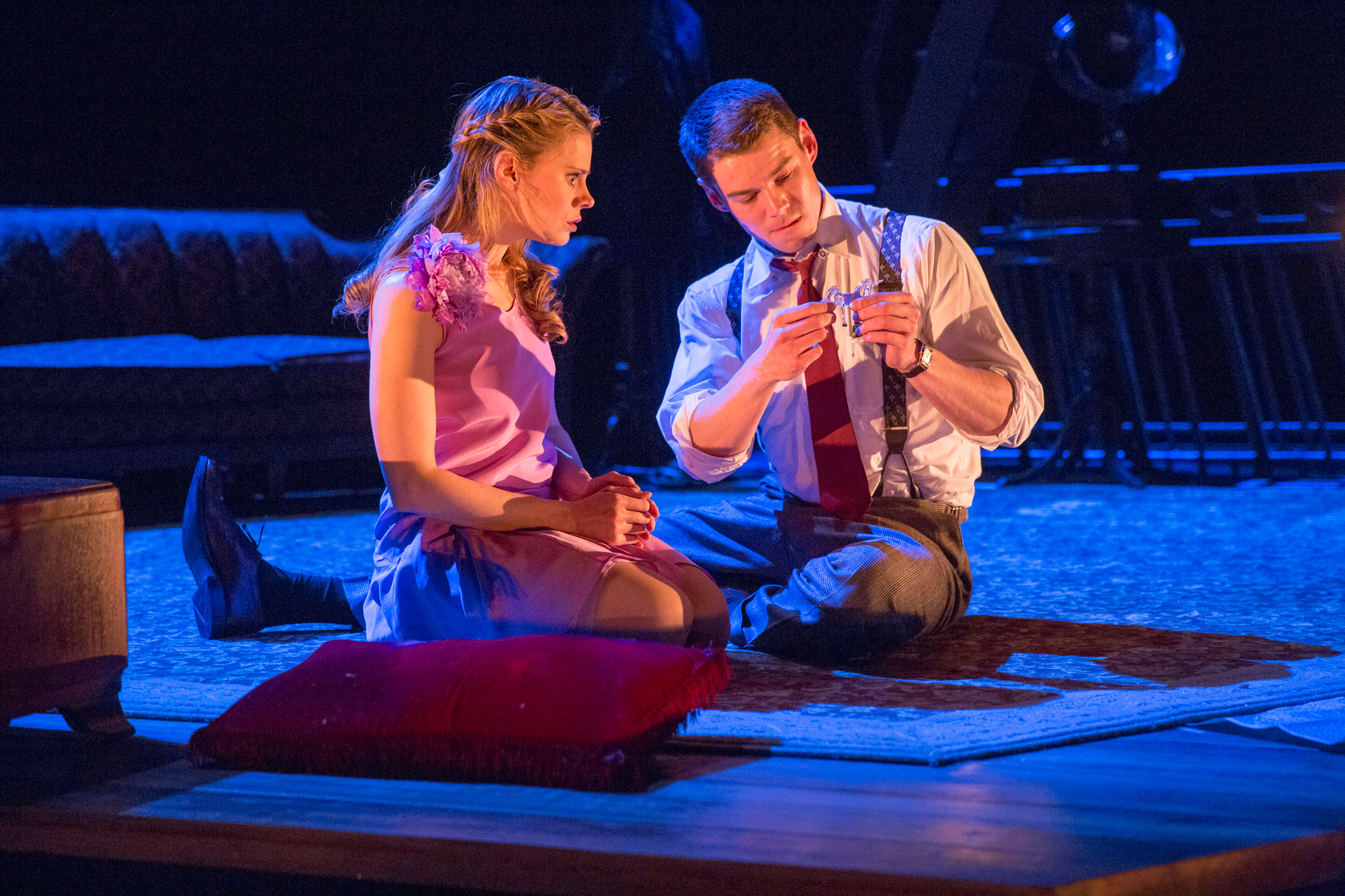
If you’ve spoken to anyone about the newest production of The Glass Menagerie on Broadway, then you already know that not one person has a bad thing to say about it. As a result, I feel like this review might end up being a little bit gratuitous – simply one more positive response to add to the mix. But if you’ll indulge me, it is a beautiful revival, literally and figuratively.
In its natural essence, as Tom states in the opening lines, Menagerie is a memory play, but I don’t think I’ve ever before seen the “memory” factor as effectively portrayed as it is in this production. We revisit Tom’s past by his side and see with his eyes what continues to haunt him to this day. Together we stumble back into his memories. Through stage magic and stylized movement, it feels almost like a dream. Which I’ve come to learn is exactly how this play should feel. This is one of those productions (similar to David Cromer’s production of Our Town at Barrow Street) where you leave thinking, “Oh. That’s how that play is supposed to be done.”
The set and lighting design alone create the space for Tom’s memories to take form. Much of the stage is dark with only certain pieces of scenery highlighted, patchy in the dark corners of his mind. There’s a fire escape that leads to nowhere and a home floating on a reflective surface. We too float in Tom’s memory. The memories are also physicalized through movement, repeated gestures, the appearance and disappearance of characters, private moments as characters loom over the edge of the living room.
Despite the beauty of the design elements, we know that most people see this play for the acting. These are four iconic roles, and across the board, these actors will not let you down. You might think you’re only going for Cherry Jones (Amanda) or to see Zachary Quinto (Tom), but Celia Keenan-Bolger (Laura) and Brian J. Smith (Gentleman Caller) are just as excellent. Quinto is enticing in his Broadway debut. His southern drawl draws everyone in from the opening moments. Keenan-Bolger gives a beautifully subtle performance as the extremely shy Laura. In the first act, she practically blends in with the scenery.
Now my experience of Amanda has always been the ultimate overbearing mother. She is a domineering, angry woman who feels burdened with her children and the abandonment of her husband. But Cherry Jones has changed my view. True, this woman is can be a lot to deal with day after day, but she cares deeply about her children. She wants the best for them and is desperately trying to lead them to “happiness and success.”
The brilliance of this play and John Tiffany’s direction is that the audience reaches intermission craving the arrival of the Gentleman Caller just as much as the Wingfields. We crave the new energy, a new character to shake up the status quo. Maybe he really will be the answer we’ve all been looking for.
Which brings me to the Gentleman Caller scene. I swear, sometimes I think that scene is all Tennessee Williams needed to write. It’s so real and beautiful and absolutely heart-breaking. This particular performance is so incredibly private and fragile; it feels like it’s just you, Jim, and Laura sitting together on the floor for hours. It was also a nice change to see a new interpretation of Jim. He isn’t portrayed as the perfect cut-out of a man. He has struggles of his own – with his work, his future, and his confidence. He and Laura aren’t so different after all. It’s astounding to me that in such a short amount of time, the entire audience can feel the same kind of crushing disappointment that Amanda feels and the guilt that plagues Tom.
The Glass Menagerie is going to be the piece that people talk about all season long. This production made me see this classic play in a completely new light. That’s the whole point of a revival, right?
The Glass Menagerie
Written by Tennessee Williams, Directed by John Tiffany
Booth Theatre through February 23rd
Photo Credit: Michael J. Lutch
Pictured: Celia Keenan-Bolger and Brian J. Smith
Macbeth
Posted: June 19, 2013 Filed under: Broadway, Play, Revival, Shakespeare | Tags: alancumming, creepydoll, macbeth, review, sleepnomore Leave a comment
It’s hard to believe Alan Cumming wasn’t nominated for this performance. What a feat. The entire production, really, is quite the endeavor. I imagine most of you know Macbeth from reading it in school, or maybe you saw Patrick Stewart in it a few years ago, or you saw the dance film noir version still playing at the McKittrick Hotel (a blog post on Sleep No More to come in the future), but you’ve almost certainly never seen all the roles played by one guy in a room. So I say again, it’s hard to believe Alan was not recognized for this tour de force. True, not all of the show was successful; I was definitely in and out of it. But when I was in, I was in.
We began with a mental hospital of sorts; light green tiles cover the walls instead of the expected white. The only inhabitants are spare cots, a sterile sink, a few chairs, a metal staircase leading up to the keypad exit, and a bathtub. An observation window lurks high above on the back wall. The lights go out and we’re immediately hit with powerful sounds, static and something like Morse code. It’s like a bad connection on a submarine or when you’re stuck in between radio stations, and it creates a super creepy vibe, particularly juxtaposed with the opening actions on stage. The sound keeps the conversation muted as two attendants check in a new patient (Cumming). They scrape underneath his fingernails, swab his cheeks, give him a shot, and collect his clothing for evidence. The man is clearly affected, traumatized. He sits, stunned, fresh bloody scratches across his upper chest, clutching one particular bag of evidence which he refuses to have taken from him. All of this business takes several minutes. I loved that they took the time to set the mood. The attendants finish up, lay him down to sleep, and depart.
And then the Shakespeare text begins. This lost man is suddenly swept up in the story of Macbeth, and his conviction skyrockets as he jumps from character to character, starting with the three weird witches right up through Macbeth’s bloody end. The script has been cut down to focus on only the major roles (Macbeth, Lady Macbeth, Banquo, Macduff, Duncan, etc). We enter the secret corners of this man’s mind as he transforms his asylum into a feast, a castle, the woods, the king’s bedchamber, and so on.
The real joy is watching Cumming switch characters in the blink of an eye. You never doubt for a second which person he is portraying at that moment. There are physical cues and even props at times, but his physicality shifts so effortlessly that they can practically be deemed unnecessary. He can get a laugh before he even speaks. During an intimate scene between Macbeth and his wife, I actually felt like I should turn away and give them some privacy.
I would say if you have the chance, check it out before it closes July 14th. Not all of the piece is as engaging as one would hope; there is a lot of text to cover and the play runs approximately 1 hour 45 minutes. I admit I found myself bored at times, but when certain scenes click, it’s extremely captivating. Only a handful of clues are sprinkled throughout about who this man might be. The audience gets to walk away speculating, filling in the back-story for themselves. By the conclusion, we have acted as bystanders to a human being falling apart at the seams. No matter how many characters he may have shared with us, he remains one heartbroken man, trapped indefinitely in his own mind and with his own crimes.

Macbeth
Written by William Shakespeare, Directed by John Tiffany and Andrew Goldberg
Ethel Barrymore Theatre
Photo Credit: Jeremy Daniel
Pictured: Brendan Titley, Alan Cumming, and Jenny Sterlin
Pippin
Posted: May 13, 2013 Filed under: Broadway, Musical, Revival | Tags: pippin Leave a comment
It’s hard to put into words how I felt about this production and still be taken seriously. I’m concerned everything I write is going to sound cliché and over-the-top. Even so, I can’t stress this enough: it really is that good. I forgot theatre could be that good. But that’s one reason I keep going back to show after show, ranging from terrible to mediocre to great. One after another, I go to the theatre hoping my mind will be blown. Like me, the audience that night was waiting to see a show that would wake up every single one of their senses.
The energy in the house was electric from the get-go. The opening chords of “Magic to Do” began, and people went crazy. It was like a rock concert. But, you know, at a Stephen Schwartz pop musical. And from those opening moments through the last, the show never falters. It builds and builds until the climactic (or is it anti-climactic?) ending. It continues to outdo itself. There were moments when I felt like I was levitating. Between the orchestrations, cast, choreography, lights, set, and circus acts, it can do no wrong in my mind, and everyone who has seen it knows this to be true (we’re clearly not including Ben Brantley in this scenario).
For those of you who don’t know the show, Pippin first hit New York in the early 1970s, Fosse-ing its way onto Broadway and winning Ben Vereen a Tony for Best Actor as the devilish Leading Player plus a handful of other awards. It is loosely based on the real-life Charlemagne (Charles the Great) and his son Pippin from the Middle Ages. Using the premise of a traveling theatre troupe, it tells the story of a young man named Pippin trying to find his place in the world and looking to achieve ultimate fulfillment. This particular production uses the framework of a Big Top and never lets up on the circus convention. Acrobats, animal cages, tricks, hoops, unicycles, and magic fill the action from start to finish, all leading to the promised unparalleled greatest finale.
If you’re already a fan of the show, it’s a treat experiencing the newly tweaked (for the better) book, and there are also some nice cuts/revisions to the songs. I can’t say enough complimentary things about the cast. If Patina Miller does not win a Tony for her work as the Leading Player, color me dazed and confused. I enjoyed her performance in Sister Act a couple seasons ago, but it’s like this role was made for her. She radiates this intoxicating energy with her strong vocals and tantalizing smile. Not to mention those fantastically toned arms. Speaking of which, this cast is beautiful. Can we talk about that for a second? Very good-looking people in astonishing shape, which is quite necessary considering some of the feats performed. The circus team is fantastic, from their mind-boggling, grab-the-person-next-to-you tricks to the more under-stated moments like Pippin’s brief conversation with a severed head. I was sorry to see that Matthew James Thomas (Pippin) and Rachel Bay Jones (Catherine, his love interest) were not recognized for their work by the Tony committee. I thought their performances were nuanced, hilarious, and beautifully sung. Terrence Mann (Charlemagne), of course, is Broadway royalty, and if you missed Charlotte D’Amboise (Fastrada) as Cassie in the recent revival of A Chorus Line, now’s your chance to see her big “Music and the Mirror” number in the form of “Spread a Little Sunshine.” For show highlights, click here and here.
So yes, as you can see, I could clearly go on and on about Diane Paulus’s brilliant production. All my reviews after this will likely pale in comparison, but seriously: go buy your tickets before Pippin wins many a Tony Award on June 9th. It is not to be missed.
And if you’re still having hesitations, just go to see Andrea Martin’s big scene as Berthe. Trust me, you will not regret it.
Pippin
Written by Stephen Schwartz and Roger O. Hirson, Directed by Diane Paulus
Music Box Theatre, Closing January 4th, 2015
Photo Credit: Joan Marcus
Pictured: Andrea Martin, Patina Miller, Terrence Mann, and the Cast of Pippin

 Becca on Broadway