
Mothers and Sons
Posted: June 17, 2014 Filed under: Broadway, Drama, Play | Tags: bobbysteggert, broadway, frederickweller, gaymarriage, mcnally, mothersandsons, review, terrencemcnally, tynedaly Leave a comment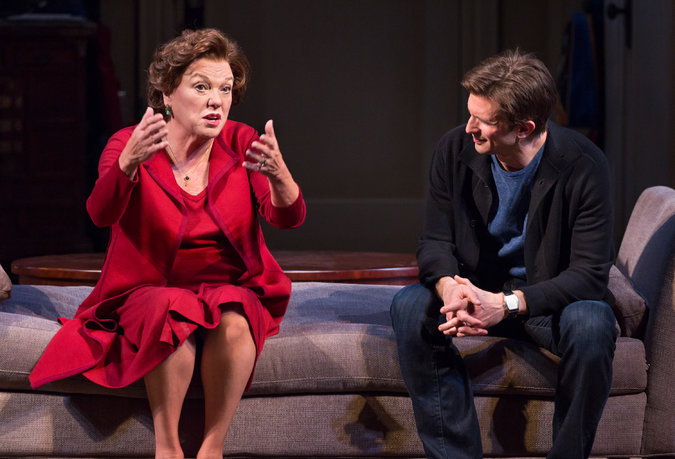
All of the feelings. All. Of. The. Feelings.
Terrence McNally’s new Tony-nominated play Mother and Sons caught me completely off guard. I was offered free tickets the night before (thanks Danny!), and before I knew it, I was sitting in the Golden Theatre with my good pal Marianne and was in for a very intense, yet incredibly funny, ride. Talk about a charged hour and a half. You can feel it in the house. Once the audience quiets down enough to truly listen, you can hear a pin drop as the characters walk around on eggshells.
We open on a mother (the excellent Tyne Daly) and her son’s ex Cal (Frederick Weller), together at his apartment on the Upper East Side where he lives with his husband and young son. We learn very quickly how she (Katharine) feels about homosexuals, her son Andre’s previous relationship with Cal, and what ultimately ended up happening to Andre. I’m not going to give anything away, not that these are monumental secrets, but the pace at which they’re revealed is important, and I don’t want to get in the way of that.
The performances are excellent. It was great to see Frederick Weller in this role, because the last time I saw him he was playing the classic best friend jack-ass in a Neil LaBute play. Bobby Steggert as his husband Will is also wonderful. And the little kid (Grayson Taylor)! I can’t even talk about it. He does such a great job. I’d never seen Tyne Daly live, and she is a force to be reckoned with. What a presence. The entire time! She creates such a nuanced, deep, striking character. The audience knows this person. We know not to mess with this woman, and yet simultaneously, we know she’s ready to break.
The play feels a little long, and as Mare pointed out, there are some repeated beats, moments of thinking “we’ve been here before,” but at the same time it remains effective. You know something is working when a character that is never seen has that much power over a room and not just over the characters but the audience as well. Katharine’s son Andre exists only in their words and our imaginations, but he may as well be on stage with everyone else.
It’s also told in real time which I personally love and have been thinking about a lot recently because The Understudy is in real time. It’s exciting for an actor to get to tell a story from the literal start to finish. There’s a change over the course of a play in general, but when it’s in real time, that change is not only over the course of the play but that particular hour and a half. Those 90 minutes have to be awfully powerful in order to warrant a story, and this one succeeds. The last twenty minutes really struck a chord with me. All of a sudden I found myself sobbing. It was an unexpected cathartic experience. I don’t remember the last time a play triggered me in this way. To go from a few controlled tears to ultimate ugly-cry-mode was not what I had expected, but boy, did it feel good.
Mothers and Sons
Written by Terrence McNally, Directed by Sheryl Kaller
Golden Theatre, Closing June 22nd
Photo Credit: Sara Krulwich
Pictured: Tyne Daly and Frederick Weller
Cabaret
Posted: May 2, 2014 Filed under: Broadway, Musical, Revival | Tags: alancumming, cabaret, emcee, lifeisacabaret, michellewilliams, review, revival, roundabout, roundabouttheatrecompany, sallybowles, sammendes 2 Comments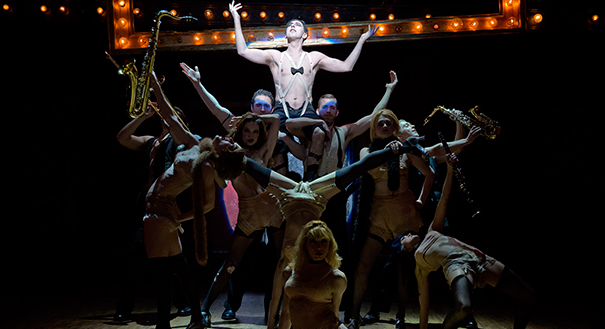
Last Thursday, I was fortunate enough to attend the opening night of the revival of Cabaret. And when I say revival, I mean that in the most literal way possible. As you may already know, Roundabout Theatre Company has remounted the Sam Mendes production that opened in 1998 and ran until 2004 (starring the late Natasha Richardson). Sadly, I missed it the first time around. Originally I had questioned the choice of putting up the same show. In my book, the point of producing a revival is to revisit a classic in a new way, to find a different angle. But boy, am I glad they did so I could see it now. It’s rare to get that kind of opportunity. Cabaret is back and once again it’s starring Tony-winner Alan Cumming as the Emcee, and together they are tearing it up at Studio 54.
Cabaret itself isn’t a flawless show – it’s long and certainly drags on in parts. There are a few songs that don’t need to be there (the pineapple song anyone?). Although you could argue that every seemingly unnecessary number contributes to the story as a whole. Every piece has a place in the puzzle – pieces that slowly build (or more appropriately, collapse) the world around us. For example, the songs Fraulein Schneider and Herr Schultz share aren’t particularly strong, but we need them in order to grow close to these characters and care about their relationship, so we can be even more distraught when things come crashing down.
It’s remarkable to me that a musical I’m so familiar with (Oh! How nice of you to ask – I was in it my senior year of college) can still be so chilling. Like the first time a swastika is revealed, you can practically hear the silent gasp emanating from the audience. And even though I know it’s coming, it’s still a punch in the gut. The same goes for “If You Could See Her (The Gorilla Song),” and basically, let’s be honest, the entirety of Act Two. It’s a one-two punch, over and over again. The fun, crazy world that is initially created is shattered as reality sinks in. That’s the beauty of Cabaret. It’s enough to make you almost forget what’s coming. It’s all fun and games with the Emcee, but the moment the kick line kicks into a goose step, we know there’s no going back.
The majority of this seamless shifting in mood can be credited to the wondrous Alan Cumming who is still ridiculously sexy, sensual, and sleazy in the role. Plus he sounds fantastic. His Emcee is a performance everyone should be lucky enough to witness. He makes it feel like a private show just for you, full of seedy antics and entertaining songs, and at the same time, creates a dark, mysterious sense of foreboding of what’s to come.
All of the supporting characters are also excellent, particularly the Kit Kat Club dancers, Fraulein Kost (Gayle Rankin), and the newly Tony-nominated Fraulein Schneider and Herr Schultz (played by Linda Emond and Danny Burstein, respectively). And even though the critics can’t agree, I will vouch for Michelle Williams. She impressed me. I’m not sure how I feel about her take on the character (although this could very well be a director’s call). Sally Bowles is larger than life, especially in Act I, and Michelle’s Sally is much more reserved and fragile. I think that fragility should be bubbling under the surface but not necessarily for the entire story. That fear and heaviness seems to be there from the start, rather than the somewhat-oblivious, party-loving girl. Still, it was interesting to see something new. And her performance of “Cabaret” is extremely powerful. I bet her performance as a whole will only get stronger and stronger as she gets more comfortable on stage.
All in all, I give Cabaret two thumbs-up. You should definitely try to see it, especially if you missed the last revival. And even if you didn’t, why not get chills all over again?
Cabaret
Music and Lyrics by John Kander and Fred Ebb, Book by Joe Masteroff, Directed by Sam Mendes, Co-Directed by Rob Marshall
Studio 54, Closing January 4, 2015
Photo Credit: Joan Marcus
Pictured: Alan Cumming and the Kit Kat Club Dancers
Violet
Posted: April 22, 2014 Filed under: Broadway, Musical, Revival | Tags: colindonnell, jeaninetesori, joshuahenry, millie, review, roundabouttheatrecompany, suttonfoster, violet 2 Comments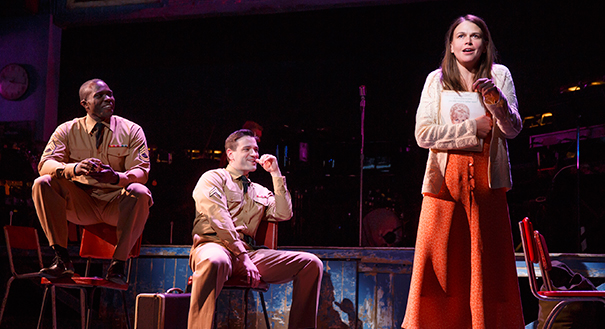
I have to say that amongst a season full of typical Broadway spectacle, it is refreshing to have a simple, understated musical as one of the options. Violet is an ultimate bare bones production: minimal staging on a minimal set. Don’t go expecting big dance numbers (the closest thing to that is the gospel number near the end). And don’t go to see money all over the stage in the form of flying carpets or a moving boxing ring. This musical is, at its core, a character study.
Based on the short story “The Ugliest Pilgrim” by Doris Betts, Violet is the tale of a disfigured woman (Violet, played by Sutton Foster) and her path to self-love. Growing up in North Carolina, Violet was raised by her widowed father and fell victim to a freak accident when her father’s axe blade came loose and struck her across the face. Thirteen years later, she embarks on a long bus journey to Tulsa, Oklahoma with the hope of being spiritually healed. On the way, she meets and grows close to two soldiers, Monty and Flick, forming an unexpected love triangle.
Even though Violet is being categorized as a revival for Tony season, this is actually the first time it has been on Broadway. There was an Off-Broadway run in 1997 for which it won the Drama Critics’ Circle Award and Lucille Lortel Award for Best Musical. After a successful concert performance at City Center Encores! this past summer, it has officially made the leap to Broadway thanks to Roundabout Theatre Company (check out some highlights here).
I decided to study the score in advance of seeing the show, listening to the cast recording countless times. There are some incredibly beautiful songs with lyrics by Brian Crawley and music by Jeanine Tesori (Thoroughly Modern Millie, Shrek the Musical, Caroline, or Change). Since I became quite familiar with the music, I went to the theatre particularly curious about the book. Unfortunately it was not as fleshed out as I’d hoped (although this may be due to the fact that the musical has been cut down to one act). The love story is somewhat lacking; I never really got on board with the triangle. I think a large problem is that aside from Violet, we don’t get much development from the other characters. Flick sings in the end, “I’m not at all the man you first laid eyes on,” but I didn’t see a change. This is by no means a comment on Joshua Henry’s performance, which is smooth as silk. I think it’s more the script that leaves me wanting. Monty, the other male lead (played by the talented Colin Donnell), remains rather bland and two-dimensional throughout as well.
Here’s the real scoop though: Sutton Foster’s a star. Did you hear? There’s this actress who was the understudy and got bumped up to the lead role in Thoroughly Modern Millie in 2002, and no one has looked back since. She deserves every Tony Award she will ever receive (two so far), every bit of praise and bit of attention she’s ever gotten. But truly, this isn’t news. Sutton shines in everything she touches, even as a character trying to hide herself from the world. From her hunched physicality, drawn-in shoulders, shielded eyes, wry humor, and using her hair as a barrier, you know who Violet is in an instant. Like in the Off-Broadway production, no make-up is used to create the scar. It is left entirely up to the imagination, and Sutton does all the work you need. This is the posture and behavior of a disfigured girl, ashamed to show her face because of how the world has treated her, and watching her transform over the course of the show is magnificent.
I hope to go back and see it again. I only saw the seventh preview or so, and I’m told it’s undergone several changes. Based on the glowing reviews the show received on Sunday night, I’m guessing things have only headed in the right direction. So even though the book felt thin to me and at times the stripped staging didn’t do much to help, I remain a huge fan of the score and this beautiful story of a girl finding herself. Oh, and of course – Sutton, Sutton, Sutton.
Violet
Music by Jeanine Tesori, Book and Lyrics by Brian Crawley, Directed by Leigh Silverman
American Airlines Theatre, Closing August 10th
Photo Credit: Joan Marcus
Pictured: Joshua Henry, Colin Donnell, and Sutton Foster
Aladdin
Posted: April 9, 2014 Filed under: Becca Doodle - Sad, Broadway, Musical | Tags: abu, aladdin, alanmenken, broadway, flyingcarpet, genie, jafar, jasmine, musical, review 1 Comment
So the critics and I haven’t been seeing eye-to-eye much of late. ROCKY received mostly negative reviews, and I think it’s one of the more exciting shows this season. Meanwhile, Aladdin received rave reviews, and to be honest with you, I didn’t think it was all that amazing. People are lapping this show up; the audience was on its feet before the bows even started. And I doubt the show will have much trouble selling tickets being that it’s…ya know, Disney’s Aladdin (albeit The Little Mermaid wasn’t much of a success).
Here’s the thing: this production is a huge and colorful spectacle, but ultimately, I thought it lacked heart – the heart that I feel is deeply a part of the movie. Lines taken directly from the film (lines that still make me cry despite having watched the movie a thousand times because it’s my favorite Disney flick) actually made me roll my eyes. I don’t think the show goes much deeper than the glitzy surface. Aladdin comes off as pretty bland, and it becomes even more apparent how much this hero lies.
My biggest complaint may be the cutting of the animals. Yeah, yeah, I know – it’s a new musical, it’s not the same as the movie, and I have to let certain things go. But I’m sorry! This is Disney! They have so much money. Figure out how to make Abu work instead of throwing him to the curb and giving Aladdin three pals who follow him around instead, churning out jokes like “I feel awful.” “Did someone say falafel?” Iago is still in it, but now he’s Jafar’s human sidekick. He does have some funny moments, but I want the parrot! Abu, Iago, and Raja are iconic characters. As far as I’m concerned, it’d be like doing Beauty & the Beast and cutting Lumiere, Cogsworth, and Mrs. Potts.
Oh, and I imagine you want to know about the flying carpet. Yes, the carpet does fly. It’s cool magic, and I don’t know how it’s done, but “A Whole New World” (one of my favorite songs of all time) falls short. The stage is dark except for the stars, and you can barely see the actors as the carpet makes its way all over the stage. The orchestrations are thinned out, and as a result, I didn’t feel the charge and excitement that typically comes hand in hand with that number.
Okay, enough negativity. Let me talk about the things that do work. You guys! Jafar is THE Jafar! Jonathan Freeman, the voice of the original Jafar, plays the role, and the kid in me definitely got a kick out of hearing him live. Some of the new songs are nice (written by Alan Menken and Chad Beguelin) and for the most part add to the story (A Million Miles Away is a lovely new tune).
Basically, the thing to know is that the Genie is the show. It should actually probably be called Genie. James Monroe Iglehart, who was also pretty darn fabulous in Memphis, gets another truly flashy role to show off his comedic and physical chops. “Friend Like Me” is an enormous production number and is the principal reason to buy a ticket. The way critics are saying it’s worth going to ROCKY for the last big fight? That’s what this song is. Nothing else matches it. (Speaking of which – why is it not the Act 1 Finale? I wonder if that’s changed since I saw it in previews. There are more scenes after that and another reprise of “Proud of Your Boy.” Bring the curtain down! Nothing can top that number!)
So listen, if you go see Aladdin, I’m sure you’ll enjoy yourself. I just felt like there were a lot of missed opportunities. There were more tricks and magic in the Finding Nemo production I saw at Animal Kingdom in Disney World. And the “wink wink nudge nudge” humor in the new material becomes so dominant that when you get to the deep-down spirit of story, the energy drops. The show is still fun as a whole, and the target audience will certainly be entertained. As for me, I think if more time had been spent on the heart of the show rather than all the mugging, I might have walked away feeling differently.
Aladdin
Music by Alan Menken, Lyrics by Howard Ashman and Tim Rice, Book and Lyrics by Chad Beguelin, Directed by Casey Nicholaw
New Amsterdam Theatre, Open-Ended
Photo Credit: Cylla von Tiedemann
Pictured: Adam Jacobs
Love and Information
Posted: April 3, 2014 Filed under: Comedy, Drama, Off-Broadway, Play | Tags: carylchurchill, churchill, loveandinformation, minettalane, nytw, review Leave a comment
Here’s something I’ve learned about myself after watching years and years of theatre: I need narrative. I crave it. That doesn’t mean it needs to be a linear narrative (LOST anyone?). But if anything, I need to be able to make connections within the piece, whether it’s through plot points, characters, clues, something more specific than thematic. It’s how I personally connect and relate. That’s what gives a story purpose for me.
Love and Information is Caryl Churchill’s new play currently being produced by New York Theatre Workshop and performed at Minetta Lane Theatre. It’s just under two hours and a collection of vignettes – moving, hilarious, and thought-provoking. Each “scene” ranges from a few minutes to a few seconds – a full conversation or perhaps a single phrase, and then it’s gone in the blink of an eye as the set swiftly changes to the next set of circumstances. These pieces are lovely to say the least – beautifully entertaining, some very funny, others heartbreaking. Plus the fantastic design (lights, set, and sound) only adds to the setting. With this style of theatre, you as an audience member have to constantly adapt to new situations and figure out what’s going on. I like having to work in that way. But then, that was it. After 45 minutes, I started to check out once I realized there wasn’t going to be a “story” in the typical sense. Not that I didn’t enjoy the rest of the scenes! If the second half had happened first, I would have appreciated those just as much. It was simply the nature of the piece as a whole that I had difficulty with. It’s hard for me to stay engaged that long to watch brief moments in time. Others may not need the narrative as much as I do. The themes and issues brought up from scene to scene may be enough to get their gears turning.
I do think it’s exciting to note that the script itself is pretty much bare-bones, not specifying place, gender, character, situation, etc. From basic dialogue on a page, the ensemble created this piece and all of the beautiful details. I love when theatre does that. I simply left craving a greater common denominator linking these vignettes other than topics of “love” and “information.”
Love and Information
Written by Caryl Churchill, Directed by James Macdonald
Minetta Lane Theatre, closing April 6th
Photo Credit: Sara Krulwich
Pictured:Noah Galvin and Adante Power

 Becca on Broadway