
Beautiful: The Carole King Musical
Posted: February 5, 2015 Filed under: Becca Doodle - Happy, Broadway, Comedy, Drama, Musical | Tags: anaturalwoman, barrymann, beautiful, broadwayreview, caroleking, carolekingbroadway, carolekingmusical, cynthiaweil, gerrygoffin, ifeeltheearthmove, jessiemueller, jukeboxmusical, musicalreview, onbroadway, onefineday, somekindofwonderful, thelocomotion, tonywinner, upontheroof, willyoulovemetomorrow, youvegotafriend Leave a comment
I’ve never been one to seek out a jukebox musical. Story is too important to me, and more often than not, that little detail falls to the wayside in this style of show. Not familiar with what a jukebox musical is? I guarantee you know one. It’s when a musical’s score is populated by songs that are already written. Typically a show will stick to one artist or band (Jersey Boys, Mamma Mia, Movin’ Out, American Idiot), or it’ll be an entire genre (Motown, Rock of Ages, The Marvelous Wonderettes). Most of the time a plot is “applied” to the music, while others are turned into a biopic, the story of how a band came to be. Beautiful: The Carole King Musical, if you haven’t guessed from the title, is one of the latter. It’s not a story based on Carole King’s music; it is Carole King’s story – how she got started in the music business, her path to fame, her hit songs with her then-husband Gerry Goffin, her heartbreaks, friendships, and everlasting kindness.
The reason this show is the success that it is? In my mind, aside from the music obviously being so damn good, it’s Jessie Mueller. Hands down. She won the Tony last year, and I was psyched to see her on stage again. I missed her Broadway debut in the Harry Connick Jr. flop, On a Clear Day You Can See Forever, but I did see her as Cinderella in Into the Woods at Shakespeare in the Park and in the revival of The Mystery of Edwin Drood. Despite Clear Day’s lack of success, Mueller made a splash and thankfully hasn’t left us since. That voice! I don’t know anyone else who makes a sound like that. And it seems she can do anything with it, shifting from style to style effortlessly (check out her pipes on Seth Rudetsky’s “Obsessed”). I suggest you catch her before her last performance on March 6th, and check out show clips here and here. And while you’re at it, watch this to see when Carole herself came to see the show, surprising the cast, after very publicly announcing that she would not be coming to see it.
Anyway, back to the show. The book is so-so. There are definitely enough songs to fill a two-and-a-half-hour musical, but there might not be enough story. Actually, that might not be the issue; I was never bored. I was frustrated with the writing itself, the actual dialogue. It’s a little cheesy for my taste, and a few scenes are written so poorly that I was actually in shock that they made it this far without being revised. But who knows, maybe it’s just me. The book is formulaic, but it’s what we’ve come to expect with biographical jukebox musicals. For example, once Carole and Gerry are on a roll writing hit after hit, the convention is set up in which they write a new song, talk about who should sing it, and then…enter The Drifters! Or The Shirelles! This happened time and time again, but I liked that each time a group sang one of the songs, a different ensemble member was featured with the solo. “The Locomotion” in particular was GREAT.
Aside from its weaker points, Beautiful comes with a chic set, Tony Award-winning sound design, fun costume changes, and King’s canon is smartly used. It’s a hoot to hear how music changes from the ’60s into the ’70s. And no matter how cliché the script can feel, it’s still lovely to watch Carole grow and gain confidence as a performer and as a human being.
Ya know, since I don’t attend many jukebox musicals, I’m not used to being in a house with an audience that has a vocal reaction every time a new tune begins. I could tell how hard the woman next to me was trying not to sing out loud. There were ladies a few rows down from us full out dancing in their seats. It was distracting at first, but once I leaned into it and accepted that it’s simply part of the drill with such classic tunes, I found myself bopping right along with ‘em.
Beautiful: The Carole King Musical
Book by Douglas McGrath, Words and Music by Carole King, Gerry Goffin, Barry Man, and Cynthia Weil, Directed by Marc Bruni
Stephen Sondheim Theatre, Open-ended
Photo Credit: Joan Marcus
Pictured: Jessie Mueller
Honeymoon in Vegas
Posted: January 9, 2015 Filed under: Becca Doodle - Sad, Broadway, Comedy, Musical | Tags: broadwayreview, brynnomalley, honeymooninvegas, jasonrobertbrown, nancyopel, newyorktheatre, nicolascage, papermill, review, robmcclure, thebridgesofmadisoncounty, tonydanza Leave a comment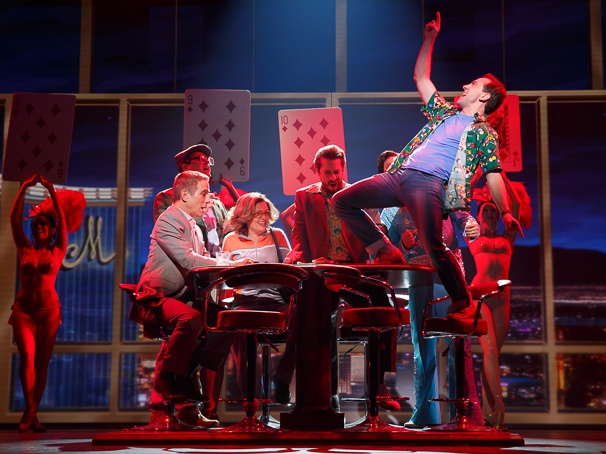
If you’re into outrageous musical comedies, then Honeymoon in Vegas is the show for you. If not? I’d honeymoon elsewhere.
I can’t remember the last time I was at such a loss for what to say about a show. I honestly don’t know if you should run toward or away from Honeymoon in Vegas. It’s one of the more absurdist musical comedies I’ve ever seen. It is one huge compilation of random, campy moments, and yet all of that happens amidst a very clear (albeit insane) storyline (check out the clips here).
I suppose if you’ve seen the 1992 film then you’re likely better prepared for the plot than Matt and I were. The movie stars Nicolas Cage, Sarah Jessica Parker, and James Caan, and from what I’ve read of the synopsis, the musical seems to stay pretty loyal. But I mean, what?? This plot! Although, Matt did point out that it was similar to how he felt watching On the Town, which also has a relatively absurd play-by-play. So you gotta be prepared to just sit back for a wild and crazy ride. That’s kind of all you can do with a show like this. You can’t sit there with your critical hat on, or try to find the logic within the madness, or have a life-changing experience as it realigns your outlook on life. Nope. Instead, tap your foot, laugh with it (and at it at times), and sit there with the goofiest smile on your face. Because when you have Vegas showgirls, a dead mother’s curse, a song called Friki-Friki, Tony Danza tap dancing, and skydiving Elvises, what else can you do?
So the plot. A guy named Jack Singer loves his girlfriend Betsy (as he makes very clear in the opening number “I Love Betsy”), but he’s afraid to pop the question. Why? Because his mother’s dying wish (ahem, curse) was that he never get married. Every time he comes close, something goes terribly wrong. But when Betsy finally puts her foot down, they fly to Vegas to tie the knot. There we meet an older gentleman, conman Tommy Korman, who tricks clueless tourists into rigged poker games and walks out with thousands of dollars. He spots Betsy at the pool and falls immediately in love because she’s a dead ringer for his dead wife. He draws Jack into a game of the aforementioned poker, and when Jack finds himself out $10,000, Tommy says they can call it even if he can have one weekend with Jack’s girlfriend. Then they all go to Hawaii.
And that’s just Act 1.
I haven’t even mentioned the Garden of Disappointed Mothers in Act 2. Can we talk about this for a second? I don’t believe this scene is in the movie, but let me paint this picture for you now. It’s one of the few heart-to-heart moments in the show as we find ourselves surrounded by a bunch of women dressed as trees. Fog is pouring off the stage so that the first three rows can barely even see. I look to my left and see Matt crying in his lap he’s laughing so hard as we notice an old man in the front row stand up in the middle of the scene to attempt to see over the fog and then give up altogether and abandon his seat. It’s a ballad between mother and son, and you’ve got the amazingly talented Nancy Opel stuck in a tiki tree costume. The juxtaposition of these things has to be intentional, but I think we were the only ones laughing, sooo your guess is as good as mine.
Rob McClure, Tony nominee for the short-lived Chaplin, is great and well cast as nebbish Jack. Betsy is played by the charming and funny Brynn O’Malley. And as the sly con artist, Mr. Tony Danza holds his own, and boy, are folks excited to see him. Opel as Jack’s mother is sadly underused, not to mention Matthew Salvidar as Tommy’s sidekick. What a waste of his talent! I wonder if he had a song that was cut somewhere along the line.
I do, though, want to say, “Good on you, Jason Robert Brown.” First, for writing an Overture and Entr’acte (what happened to those, friends?) and highlighting the fabulous orchestra. But also, for writing this fun, jazzy, over-the-top music immediately following last season’s The Bridges of Madison County for its lush, romantic, Tony-winning score. It’s hard to believe they’re written by the same composer.
Honeymoon in Vegas starts off so strong. It’s campy and knows it. But when the characters head to Vegas, I found myself less on board. It was like a game of tug-of-war; I kept giving up, and then the most insane thing would happen, and I’d find myself smiling. And then I’d get fed up all over again. I try to avoid quoting other critics, but I think Ben Brantley hits it on the head in his (note: incredibly positive) review from the Papermill Playhouse run: “It’s a swinging hymn to laid-back outrageousness.”
And as my pal Matt put it, “I had fun!! Do I think it’s a good musical?…No.”
Honeymoon in Vegas
Book by Andrew Bergman, Music and Lyrics by Jason Robert Brown, and Directed by Gary Griffin
Nederlander Theatre, Open-ended
Photo Credit: Joan Marcus
Pictured: Tony Danza and Rob McClure and the Cast of Honeymoon in Vegas
Into the Woods: The Movie
Posted: January 6, 2015 Filed under: Comedy, Drama, Miscellaneous, Movie, Musical | Tags: annakendrick, bakerswife, becarefulwhatyouwishfor, chicago, childrenwilllisten, chrispine, cinderella, emilyblunt, fairytales, filmreview, giantsinthesky, happilyeverafter, intothewoods, intothewoodsfilm, iwish, jamescorden, jameslapine, littlered, merylstreep, rapunzel, robmarshall, stephensondheim 5 Comments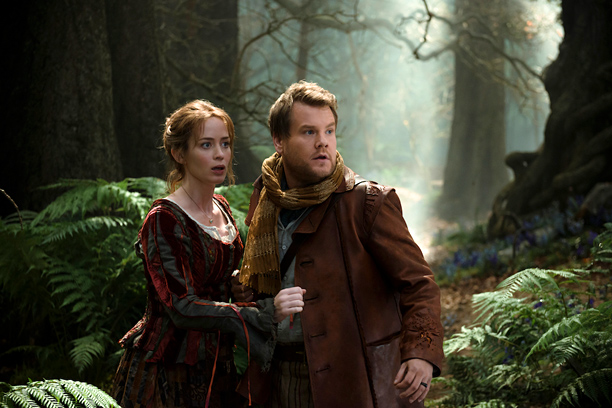
Let’s talk Into the Woods, shall we?
First, some history about this show and me; I feel it’s important that you know where I’m coming from. I grew up watching Into the Woods. If you don’t know the story, the Stephen Sondheim musical puts all of our favorite fairytale characters in the same world and shows us what happens after “happily ever after.” As I mentioned in my last Video Friday, the 1987 original production was filmed live and aired on TV in 1991. My parents, in one of their wisest decisions ever, taped it, and I wore that VHS tape to bits. The video quality was so bad that when the DVD was released, I remember watching it for the first time thinking, “Woah, Bernadette’s dress is PURPLE!” If there’s one thing I’ve seen more than anything else in my 30 and a half years on this planet, it’s this stage version.
When the Rob Marshall film was announced, I tried to remain as neutral as possible, not wanting to get my hopes up. But over the past few months, the more clips and interviews I saw, the more excited I got – I couldn’t help myself! It actually looked like they were going to do it justice. There are many reasons why it’s exciting to put a musical (or any play for that matter) on film. It’s an opportunity to do things on screen that are too difficult or expensive to execute on stage. Into the Woods is a great example of the possibilities that open up once you are allotted a Disney budget: a 64-piece orchestra, a stunning forest, a real palace, a real COW, etc.
Okay, enough stalling – let’s get to the heart of the matter. Bottom line? I loved it. There, I said it. They did a damn fine job. It looks and sounds beautiful, and I already went back to see it a second time with my friend Little Red. A lot of the success relies on the cast, and they knock it out of the park. Two years ago upon the release of Les Misérables, many complained (myself included) about some of the casting. I love Eddie Redmayne, but there are better singers out there for Marius. Objectively speaking, Amanda Seyfried and Russell Crowe don’t have the same vocal talent as Hugh Jackman and Aaron Tveit. These key casting mistakes hurt the movie, but Marshall gets it right with Woods. There’s talent across the board. I’ll highlight a few of my favorites (please note: I am intentionally not going to talk about Johnny Depp because I truly do not know how I feel about that wolf).
If I hadn’t previously heard Chris Pine sing on Jimmy Kimmel Live, I might have thought his voice was dubbed. Who would’ve guessed that man could croon? He’s so brilliantly cast as Cinderella’s Prince, with that fine-looking coif and just as fine-looking a face, and gives a perfectly balanced over-the-top performance. “Agony” is one of those songs that can crash and burn if you don’t have the right actors. Pine, and Billy Magnussen as Rapunzel’s Prince (Spike of Vanya and Sonia and Masha and Spike), had me laughing up a storm.
I’ve learned recently that there are people who don’t like Anna Kendrick (Cinderella). I did not know this was possible! I think she’s great in everything, and this was no exception. “On the Steps of the Palace” is excellent. Period. I adore the changes they made to this song: tweaking the lyrics to present tense and first person, stopping time as Cinderella sifts through her options, and putting her literally on the steps of the palace. These adjustments make the song more active and packed with discoveries. I also enjoy seeing Cinderella choose to deliberately leave the slipper behind.
I love seeing actual kids in the roles of Jack (Daniel Huttlestone) and Little Red Riding Hood (Lilla Crawford). More often than not, on stage you’ll see actors in their 20s, or even 30s, who “look young” playing these parts. Having children play children, especially in a musical about children, brings a whole new level to the piece. “Your Fault” becomes more pointed when you see adults arguing with little kids about who’s to blame. Little Red’s dare to Jack holds more weight because dares mean more at that age. “No One is Alone” resonates all the more when you see young children who’ve lost loved ones.
I’m on such an Emily Blunt kick right now. Gosh, I love her. And she’s damn good in this. It’s hard to take on a role iconized by Joanna Gleason in my book, but she makes it her own and is a joy to watch. She and James Corden play off of each other well, and they’re a pair you want to root for (“It Takes Two” = adorable). Side bar (SPOILER): I appreciate the extra emphasis placed on the Baker’s Wife’s interest in Cinderella’s Prince. There are multiple hints in the script that she’s drawn to him, but on stage, I’ve only seen them delivered as punch lines or portrayed as a surface attraction. Blunt’s interpretation felt like a legit, tangible fantasy of hers, making it more believable that when he’s wooing her later on, she caves.
Do we even need to talk about Meryl? I mean, really. The woman is unstoppable. The bitch can skate. Moving on…
On to my negative feedback (SPOILER alert for the next three paragraphs). My major critique has to do with the shifts in mood in the second half. There was much concern leading up to the opening of this movie that the musical would be “Disneyfied” (although, you could argue that other Disney films are just as dark – how many protagonists actually have two living parents?). Regardless, people feared that Disney would suck the darkness out of these doomed fairytale characters. After seeing it, I would say that yes, it is not as dark as the live show, but it was not nearly as “Disneyfied” as it could have been.
One of the reasons the “second act” isn’t as bleak is the off-screen deaths. The punch to the gut is less effective when these deaths are merely suggested. For example, I genuinely did not know whether or not Jack’s Mother died. In the original version, it’s a much more deliberate strike by the Prince’s Steward, and we witness her last words. Now she’s awkwardly pushed, and her death is only implied. As a result, I did not head into the next scene with the same heaviness I typically feel. On stage, when we first meet the Giant in person, the Narrator (who has been cut from the film), Rapunzel, and Jack’s Mother all die within five minutes of each other. It’s traumatic, overwhelming, and happens so quickly that we barely have time to register it all. Now that the Narrator is gone, Rapunzel doesn’t die, and Jack’s Mother’s death is unclear, I found myself taking the dramatic turns less seriously.
The change I can’t support, and my biggest problem with the film, is the end of Rapunzel’s story. It is a mistake to let her live. Her death is crucial for the weight of the second act, particularly the Witch’s arc. Her “Lament” is not about Rapunzel running off with the Prince (which is typically at the end of Act 1); it’s about real loss. The Giant steps on Rapunzel right in front of her mother’s eyes. This tragic loss of her daughter is what drives the Witch the remainder of the show. Why else would she be so desperate to find Jack and feed him to the Giant? Why else would she stick around with these people who make her crazy? All that exasperation builds to “The Last Midnight” when she finally explodes. The song is less earned without Rapunzel’s death. Don’t get me wrong – Meryl is fantastic and it’s a good number, but it doesn’t feel grounded without the backstory. The stakes are a lot lower when sh*t doesn’t go down.
As for the song cuts, they make sense to me. It’s a hard thing to cut a half hour from a musical. Of course I’m sad that “No More” isn’t included, and it’s odd not to have the opening of Act Two. I wish (ha) the passage of time were still there so we could see these characters wanting more all over again, even though they just got their wishes. Here is an interview with the book writer, James Lapine, in which he discusses the process of adapting the stage script to film.
I know there are upset fans who are angry about the changes, saying the movie could never top the original. To that I say, of course it wouldn’t be the original musical; that’s not the intention. The movie isn’t here to replicate the stage show – rather it’s one more interpretation of this wonderful story. It’s a chance to shine new light on it for the fans, and perhaps more importantly, for the people who’ve never had the chance to see it. I read on Playbill.com that “in its first weekend, “Into the Woods” was seen by four times the amount of people than those who saw both Broadway runs combined.” We have to treat this movie like a revival – a creative team trying something new. So as far as this attempt goes, I say, “Brava.” Brava for staying as loyal to the script as possible, casting actors who can sing, and having Lapine and Sondheim involved every step of the way.
You know, another thing I’ve noticed in reviews is an odd contradiction regarding how people feel about the latter half of the story. Like I said, fan are disappointed that it’s not as dark (I, too, lean in this direction). But then there are the people who are upset that the second part even happens, saying quit while you’re ahead. Why does it need to get dark when a perfectly good ending has already been established? Why not wrap things up at Happily Ever After?
But isn’t it more interesting to go beyond and see what’s next? Because that is when real life happens. And shouldn’t we want to sing about that, too?
Into the Woods
Music and Lyrics by Stephen Sondheim, Screenplay by James Lapine, Directed by Rob Marshall
Pictured: Emily Blunt and James Corden
On the Town
Posted: November 19, 2014 Filed under: Becca Doodle - Happy, Broadway, Comedy, Musical, Revival | Tags: adolphgreen, bettycomden, broadway, broadwayreview, helluvatown, johnrando, leonardbernstein, newyorknewyork, newyorktheatre, onthetown, onthetownrevival Leave a comment
Fantastic dancing and a bright, talented cast make this one helluva revival.
For those of you out there who say you don’t know On the Town at all, I guarantee that you know at least one song. Originally produced on Broadway in 1944, it was also made into a film starring Gene Kelly and Frank Sinatra later that decade. The story doesn’t go far below the surface. It’s about three sailors trying to get laid during their 24-hour shore leave in New York City. Yup. That’s the Leonard Bernstein musical in a nutshell. But for an old-timey classic, it’s dirtier than you might expect, packed with innuendos and euphemisms.
It’s a funny thing about revivals. When a new show comes out, most of the reviews are about the content – the quality of the book and music. With something this old-school, no one is commenting on the quality of the show itself; instead it’s about the production. How the material is approached this time around. And when you’ve got John Rando at the helm (Tony winner for Urinetown), you know you’re in good hands. The production value is fantastic, the choreography stunning, plus a funky design, and an awesomely talented cast.
On the Town was the first production I was cast in at Muhlenberg; my sophomore year I played…wait for it…the Little Old Lady. She’s literally a running gag, randomly running across the stage throughout the show. The always-funny Jackie Hoffman doubles as the Old Lady and Madame Dilly (actually she pops up as other random characters, too). The focus, though, is on the six stars (the main sailors and their respective matches), and they all get a chance in the spotlight. Tony Yazbeck as Gabey is such a beautiful dancer to watch. His Tulsa really struck me in the Gypsy revival as well. Jay Armstrong Johnson’s Chip is goofy and lovable, and Clyde Alves as Ozzie never runs out of energy. Megan Fairchild plays Ivy with simple grace, and her big dance sequence with Yazbeck in the second act is wonderful. I love Elizabeth Stanley in everything, and she doesn’t disappoint as Claire de Loone. And this was my first introduction to Alysha Umphress as Hildy; that girl’s got pipes (here she is singing I Can Cook, Too).
So why see On the Town now? In the current decade? Matt and I debated this on the ride home. It’s a return to a simpler time for sure. Escapism at heart, right? Musicals today tend to make you think more (or at the very least, Sondheim intellectualized some of them). While escapism, fluff, bubblegum (whatever you want to call it) still come and go on the Broadway stage, there certainly aren’t contemporary shows with dancing like this anymore. We were trying to think of a modern musical that has full-on dance (maybe Thoroughly Modern Millie comes close?). Sure, there are dance numbers/breaks, but songs fully dedicated to dance are few and far between. You’ll typically only see that in revivals like Anything Goes, The Music Man, 42nd Street, etc. On the Town provides the eight-minute long dance sequences we’ve been missing, and this revival doesn’t flounder in that department. It features beautiful pas de deux and ensemble work (highlights here). The choreography and execution are gorgeous in this production and one of the best reasons to go see it. And it’s not just the ensemble – this is a show in which the principles have to be real dancers as well. You know it’s a legit dance show when the lead woman is New York City Ballet’s #1 ballerina.
So yes, it may be a random, at times senseless plot (with some objectifying of both genders thrown into the mix for good measure), but for a great Greene/Comden/Bernstein throwback, classic show tunes, and beautiful dancing, I say it’s worth a trip to go get Carried Away.
On the Town
Music and Lyrics by Leonard Bernstein, Book and Lyrics by Betty Comden and Adolph Green, Directed by John Rando
Lyric Theatre, Open-ended
Photo Credit: Joan Marcus
Pictured: The Cast of On the Town
It’s Only a Play
Posted: November 12, 2014 Filed under: Becca Doodle - Sad, Broadway, Comedy, Play, Revival | Tags: broadway, ferrisbueller, harrypotter, itsonlyaplay, matthewbroderick, mcnally, meganmullally, nathanlane, newyorkreview, newyorktheatre, review, ronweasley, rupertgrint, stockardchanning, terrencemcnally, thenance, theoddcouple, theproducers Leave a comment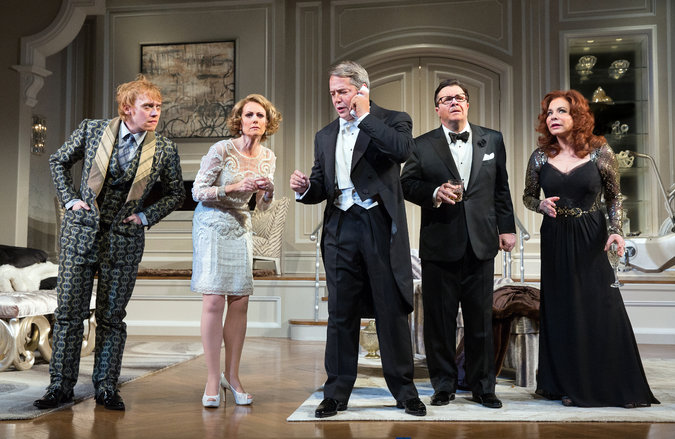
This Terrence McNally revival packs a lot of star power but no punch.
Listen folks, I’m sorry to report that I was disappointed by It’s Only a Play. Matt and I were very much looking forward to it, and being that it’s one of the hottest tickets, this was one of our splurges money-wise this season. With its starry cast, stellar creative team, and modernized script, we figured we couldn’t go wrong.
The loose plot centers around a group of theatre people at an opening night party awaiting the reviews, primarily the Times. You’ve got the producer (Megan Mullally), the playwright (Matthew Broderick), the director (Rupert Grint), the star (Stockard Channing), a critic (F. Murray Abraham), the playwright’s friend who passed on the project (Nathan Lane), and the coat check boy (“introducing Micah Stock”). All in one room told in real time (click here for highlights).
Things start out amusingly enough. I mean, I’ll watch Nathan Lane live anytime with a perfectly content smile on my face. There’s a section early on with just him on stage, and I would have been happy if the whole play had been that. Maybe I’ll go watch The Nance on PBS instead and revisit that production.
It’s Only a Play is overflowing with inside jokes about the theatre world, many of which would completely go over the average theatre-goer’s head. McNally has updated all of the now-dated references to today’s celebrities and to more recent theatre tiffs (e.g. Shia LaBeouf, Alec Baldwin). Practically every show currently running on Broadway is thrown into the mix, and it gets old fast. There is more name-dropping in this show than…um…just trust me. Hilary Clinton, Denzel Washington, Frank Langella, Lady Gaga, a whole lotta names – most of which are mentioned alongside jokes at their expense. There are so many punchlines that are equivalent to a celebrity shout-out that it started to get on my nerves. Those are cheap shots in my book (although the malicious jokes didn’t seem as malicious coming out of Lane’s mouth).
Matthew Broderick’s stiff performance falls flat with his consistently understated and monotone delivery. Any energy that is built up by the other characters collapses around them when he arrives onstage. He has a huge speech in the first act (which ends with the line: “Speech done”) when he gets up on a soap box and talks about the theatre today and how its integrity is basically falling apart at the seams. What have we done to it? Remember the good old days? And so on and so forth. People applauded like crazy afterward, yet I sat there feeling insulted. I understand the self-awareness aspect of referencing the trend of movie stars taking over Broadway and names above the title, and that’s what this play is doing too (get it??), but it didn’t come across as witty to me. [title of show] did the self-aware comedy much more effectively and humorously. Nathan Lane’s character referring to the actor Nathan Lane for an easy laugh? Come on. There was so much applause after lines, big speeches, entrances, and exits, I couldn’t wrap my head around it. Were the people around us clapping for the play? The production? Or just the stars they love? Does Stockard Channing leaving the stage after saying something triumphantly warrant exit applause? If it had been any other actor, would the audience have cared?
Wow, I’m starting to sound bitter. Let me dial it back, and get back on topic. Take a breath, Becca.
Perhaps I’m not the target audience. I know that the most of the reviews tell me I’m in the minority, but neither Matt nor I laughed much. Grint was a caricature, as was Mullally. This approach could maybe work if everyone was giving the same stylized performance, but with Broderick, for example, playing everything down, you’re left with a bunch of people in different plays. One of the things that makes You Can’t Take It With You such a hit in my book is that it has a cast of fully-realized individual characters who all could be the star of the show with their crazy antics, but simultaneously, they’re in sync with one another. That family is under the same roof and in the same play, whereas It’s Only a Play’s characters all seem to be attending different opening night parties.
It’s Only a Play
Written by Terrence McNally, Directed by Jack O’Brien
Schoenfeld Theatre, Closing January 4, 2015
Photo Credit: Sara Krulwich
Pictured: Rupert Grint, Megan Mullally, Matthew Broderick, Nathan Lane and Stockard Channing

 Becca on Broadway