
Constellations
Posted: January 13, 2015 Filed under: Becca Doodle - Happy, Broadway, Drama, Play | Tags: broadwayreview, constellations, jakegyllenhaal, manhattantheatreclub, mtc, nickpayne, nightcrawler, rabbithole, review, ruthwilson, theaffair 2 Comments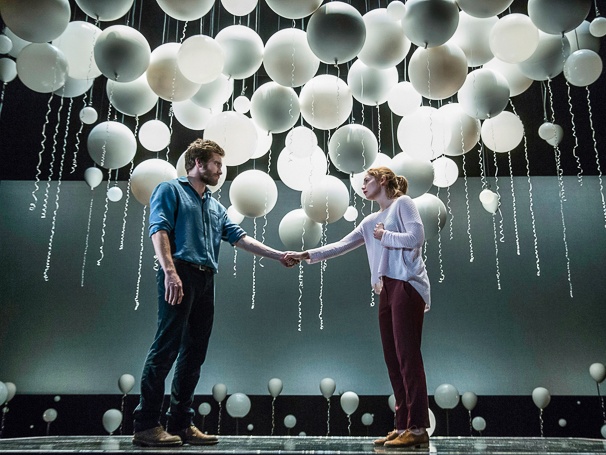
Picture a fight you have with someone and how it can go ten different ways. If you had only said something different or used a different tone of voice, you may have ended up with an entirely different outcome…or not.
This is exactly what Nick Payne’s Constellations explores. Not just the concept, though; the 70-minute play examines the actual possibilities, the numerous pathways two characters can take in their relationship – all the potential ways a conversation can go when they first meet at a BBQ, when they consider spending the night together, when they’re faced with life-altering events.
Jake Gyllenhaal as Roland and (Golden Globe Winner!) Ruth Wilson as Marianne give wonderfully warm, generous, and connected performances. Watching this play is like being in an acting class with them because they’re playing these scenes over and over with a new interpretation each time. It’s all about tactics. When an actor approaches a scene, he or she has to figure out a) what do I want? and b) how am I going to get it? That’s what these two are doing in real time. They do eventually shift out of a certain scene and into another as they move forward in time (or do they?), but even when they’re saying the exact same words as the time before, it’s still fresh. And I believed them each time. The audience adapts to the new circumstances just as quickly as the characters do, and that is a testament to the writing.
When I go down the rabbit hole of thinking about other universes and how many lives I might be leading elsewhere, I start to get dizzy. The play asks questions like: do we have control over our fate? Does free will exist if we are just one version of ourselves and all the other “choices” we could make are simply playing out in another universe? And what about time itself? Are the past and future merely fabrications, only kept alive in our own minds?
There is an element of the play building on itself – the sound and lighting designs (both enticing) growing more intense and cutting – as things develop and the story(ies) become more clear. I did think, however, that it was building to something, and I don’t know if that something ever arrived. Should there be a catharsis of some kind? Is there an ending? How can there be an ending when there are over 50 stories potentially being told? Because of this, the play as a whole feels somewhat incomplete. Unfinished even.
But maybe that’s exactly the point.
Constellations
Written by Nick Payne, Directed by Michael Longhurst
Samuel J. Friedman Theatre, Closing March 15th
Photo Credit: Joan Marcus
Pictured: Jake Gyllenhaal and Ruth Wilson
Kneehigh’s Tristan & Yseult
Posted: December 18, 2014 Filed under: Off-Broadway, Play | Tags: briefencounter, broadwayreviews, kneehigh, kneehightheatre, newyorktheatre, offbroadwayreview, reviews, stanns, stannswarehouse, tristan, tristanandyseult, yseult Leave a comment
You can always count on Kneehigh Theatre for a whimsical treat for the soul.
When I first heard St. Ann’s was presenting the theatre company Kneehigh’s production of Tristan & Yseult, I jumped at the opportunity to go. Plus I got to see it with Shannon, one of my favorite people, who was visiting from Chicago last week (to launch Brontosaurus Haircut Productions!). Kneehigh’s style is right up our alley so we were eager to drink in the performance. I’m sorry to say that the run ended on Sunday night, so unfortunately I can’t recommend that you go see it (slash I’ll keep this brief). But here’s the trailer to give you a taste.
One of the reasons I’m drawn to Kneehigh is their seamless threading of storytelling with dance, music, and physicality. It’s consistently innovative, exciting, and unexpected. I got to see Brief Encounter at Roundabout Theatre Company in 2010, and while I don’t recall specifics (except the swinging on chandeliers), I definitely remember how it made me feel. I remember being awed, thrilled, and challenged by the acrobatics, ideas, and designs. It was simply beautiful (here’s the clip reel).
Their newest production is the story of Tristan and Yseult, your classic case of star-crossed lovers. We are greeted by a group of self-declared “Lovespotters,” who also introduce themselves as the unloved in this world. They are all dressed in uniform track jackets, hoods up, carrying around notepads and binoculars as they search for signs of love (this ensemble also doubles as the characters of the main story). I loved the unloved. They were like the minions in “Despicable Me” – working in unison, saying random things, singing and stomping around, and called names like Steve and Kenneth. They’ve also been known to croon sappy love songs and modern pop songs with the kick-ass band at the Club of the Unloved.
Even though I can’t recommend this particular play, I can tell you to keep your eye out for Kneehigh shows. We went on a journey of love, heartbreak, song, and dance as these characters sailed on ships, battled, and flew in the air. The storytelling is quirky and light until you realize just how heavy-hearted things can be.
Kneehigh’s Tristan & Yseult
Written by Carl Grose and Anna Maria Murphy, Adapted and Directed by Emma Rice
St. Ann’s Warehouse, Closed December 14, 2014
Photo Credit: Sara Krulwich
Pictured: Dominic Marsh and Hannah Vassallo
It’s Only a Play
Posted: November 12, 2014 Filed under: Becca Doodle - Sad, Broadway, Comedy, Play, Revival | Tags: broadway, ferrisbueller, harrypotter, itsonlyaplay, matthewbroderick, mcnally, meganmullally, nathanlane, newyorkreview, newyorktheatre, review, ronweasley, rupertgrint, stockardchanning, terrencemcnally, thenance, theoddcouple, theproducers Leave a comment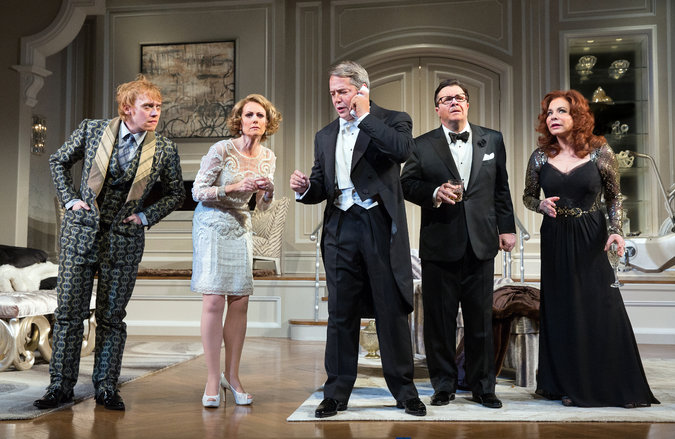
This Terrence McNally revival packs a lot of star power but no punch.
Listen folks, I’m sorry to report that I was disappointed by It’s Only a Play. Matt and I were very much looking forward to it, and being that it’s one of the hottest tickets, this was one of our splurges money-wise this season. With its starry cast, stellar creative team, and modernized script, we figured we couldn’t go wrong.
The loose plot centers around a group of theatre people at an opening night party awaiting the reviews, primarily the Times. You’ve got the producer (Megan Mullally), the playwright (Matthew Broderick), the director (Rupert Grint), the star (Stockard Channing), a critic (F. Murray Abraham), the playwright’s friend who passed on the project (Nathan Lane), and the coat check boy (“introducing Micah Stock”). All in one room told in real time (click here for highlights).
Things start out amusingly enough. I mean, I’ll watch Nathan Lane live anytime with a perfectly content smile on my face. There’s a section early on with just him on stage, and I would have been happy if the whole play had been that. Maybe I’ll go watch The Nance on PBS instead and revisit that production.
It’s Only a Play is overflowing with inside jokes about the theatre world, many of which would completely go over the average theatre-goer’s head. McNally has updated all of the now-dated references to today’s celebrities and to more recent theatre tiffs (e.g. Shia LaBeouf, Alec Baldwin). Practically every show currently running on Broadway is thrown into the mix, and it gets old fast. There is more name-dropping in this show than…um…just trust me. Hilary Clinton, Denzel Washington, Frank Langella, Lady Gaga, a whole lotta names – most of which are mentioned alongside jokes at their expense. There are so many punchlines that are equivalent to a celebrity shout-out that it started to get on my nerves. Those are cheap shots in my book (although the malicious jokes didn’t seem as malicious coming out of Lane’s mouth).
Matthew Broderick’s stiff performance falls flat with his consistently understated and monotone delivery. Any energy that is built up by the other characters collapses around them when he arrives onstage. He has a huge speech in the first act (which ends with the line: “Speech done”) when he gets up on a soap box and talks about the theatre today and how its integrity is basically falling apart at the seams. What have we done to it? Remember the good old days? And so on and so forth. People applauded like crazy afterward, yet I sat there feeling insulted. I understand the self-awareness aspect of referencing the trend of movie stars taking over Broadway and names above the title, and that’s what this play is doing too (get it??), but it didn’t come across as witty to me. [title of show] did the self-aware comedy much more effectively and humorously. Nathan Lane’s character referring to the actor Nathan Lane for an easy laugh? Come on. There was so much applause after lines, big speeches, entrances, and exits, I couldn’t wrap my head around it. Were the people around us clapping for the play? The production? Or just the stars they love? Does Stockard Channing leaving the stage after saying something triumphantly warrant exit applause? If it had been any other actor, would the audience have cared?
Wow, I’m starting to sound bitter. Let me dial it back, and get back on topic. Take a breath, Becca.
Perhaps I’m not the target audience. I know that the most of the reviews tell me I’m in the minority, but neither Matt nor I laughed much. Grint was a caricature, as was Mullally. This approach could maybe work if everyone was giving the same stylized performance, but with Broderick, for example, playing everything down, you’re left with a bunch of people in different plays. One of the things that makes You Can’t Take It With You such a hit in my book is that it has a cast of fully-realized individual characters who all could be the star of the show with their crazy antics, but simultaneously, they’re in sync with one another. That family is under the same roof and in the same play, whereas It’s Only a Play’s characters all seem to be attending different opening night parties.
It’s Only a Play
Written by Terrence McNally, Directed by Jack O’Brien
Schoenfeld Theatre, Closing January 4, 2015
Photo Credit: Sara Krulwich
Pictured: Rupert Grint, Megan Mullally, Matthew Broderick, Nathan Lane and Stockard Channing
The Real Thing
Posted: October 22, 2014 Filed under: Becca Doodle - Sad, Broadway, Drama, Play, Revival | Tags: broadway, cynthianixon, ewanmcgregor, itsaboutyou, maggiegyllenhaal, moulinrouge, review, roundabout, samgold, therealthing, tomstoppard Leave a comment
If you went to high school with me, then you know I fell in love with Ewan McGregor when I was 17-years-old, saw “Moulin Rouge” for the first time, and my young mind exploded. You also know that I had a Seth Green phase earlier in high school, but let’s move past that for the moment. After I proceeded to watch as many of Ewan’s films as I could the following year, I eagerly awaited the moment to see him in a live play (since I tried and subsequently failed to see him in Guys and Dolls when I was studying abroad in England). So yes, I admit, Ewan was the primary reason I wanted to attend the newest revival of Tom Stoppard’s The Real Thing.
Henry (Ewan McGregor) is a playwright. His current play is about a woman who cheats on her husband, starring his wife Charlotte (Cynthia Nixon) and an actor named Max (Josh Hamilton). In real life, Max is married to Annie (Maggie Gyllenhaal). When we learn that Henry and Annie are actually having an affair, art begins to imitate life. Or is it the other way around?
Sadly, this production left me wanting in many ways. I wasn’t invested in these characters, emotionally or intellectually. They don’t need to be sympathetic (which they aren’t) for me to be invested, but I still have to want to go on a journey with them. Instead I felt left behind. This was in part due to the story itself being confusing at times (intentionally), and it can be hard to follow because the language is so dense. But that aside, I couldn’t connect to the style itself. It was very presentational and plotted out. Rather than discovering on the line, all of the words seemed planned. If a character had a big speech, it was performed like he or she had memorized it and had reached the appropriate time to recite it. It did not feel spontaneous.
Matt and I were discussing that maybe this was because of the slightly heightened, highly intellectual language, but on the other hand, Shakespeare is heightened and poetic. Even if you don’t catch all of the metaphors, subtext, and meanings in the first hear-through, you are still with the characters. You’re discovering things together, in the moment, no matter the density of the words. For example, when I saw the revival of Stoppard’s Arcadia a few years back, I went in blind, and while I was desperately confused at times (lots of math talk in that play), I still felt like I was there with the characters, going through something with them, trying to figure it out together.
The Real Thing won a Tony Award for Best Play in 1982 and Best Revival of a Play in 2000. It took home the Drama Desk, and the leads won Tony Awards in both productions. I mean, it makes sense! Stoppard is one of our most popular playwrights, known for his intense, philosophical, beautiful dialogue and topics. And I love all four of these actors in their other works. I think the root may be a direction/style choice. I’m curious what the previous productions did differently that made them so successful.
This play is about love, marriage, and in/fidelity. It’s about the feelings that are left unsaid, acting the opposite, playing it cool. We find out rather quickly that the first scene is a performance, a play within a play, but come the second scene in “reality,” it still feels like a performance. This might have been the point, as it partly represents the lack of honesty being shared among the characters, but then again, there needs to be a contrast. There are only a couple of moments with that kind of truth sprinkled in (Ewan has a touching moment alone onstage in the second act that I appreciated). I don’t mean that the characters need to show this truth to each other, but the vulnerability could be shared with us. Someone should be honest with the audience and make that connection, if only for a moment, because we want, we need the real thing.
The Real Thing
Written by Tom Stoppard, Directed by Sam Gold
American Airlines Theatre, Closing January 4, 2015
Photo Credit: Joan Marcus
Pictured: Maggie Gyllenhaal and Ewan McGregor
Scenes From a Marriage
Posted: October 15, 2014 Filed under: Becca Doodle - Happy, Drama, Off-Broadway, Play | Tags: heddagabler, ingmarbergman, ivovanhove, newyorktheatreworkshop, nytw, scenesfromamarriage, susannahflood Leave a comment
What a fascinating, innovative, different type of play experience. Of course, I’d expect no less from an Ivo van Hove production. The Flemish director often revisits New York Theatre Workshop to reinvent plays as we’ve come to know them. When I saw Hedda Gabler starring Elizabeth Marvel in 2004, it completely changed my view of theatre. He’s also directed A Streetcar Named Desire, The Misanthrope, and The Little Foxes there. Ivo strips plays down to the characters’ most primitive instincts and then heightens them all over again, leaving you with a very different approach than the original you had come to expect. Scenes From a Marriage is his newest project, based on the 1973 Ingmar Bergman TV mini-series.
As the title hints, we bear witness to different scenes from the same marriage. During Act I, the stage is split into three separate sections. When you arrive for the show, you’re given a colored wristband determining which room you enter first. Within the three rooms are three different sets of actors playing the same couple, Johan and Marianne, at different stages of their marriage, from its more promising beginnings to later struggles. In the first room, timeline-wise, are Alex Hurt and Susannah Flood, 10 years into their marriage. A half hour later you move into the next room to see Dallas Roberts and Roslyn Ruff playing the same couple later on, and lastly are Arliss Howard and Tina Benko working through the remains at the end. Meanwhile, the scene(s) you already watched are replaying beyond the thin walls. You can hear the fights, ones you’re familiar with and ones you have yet to hear – the echoes of past and future battles that resonate throughout the story.
The majority of the second act is absolutely thrilling. The theatre is transformed into one large open space, and as the six actors enter (together this time), the audience begins to prep itself for the roller coaster ride they expect is coming. The scene begins as the characters alternate lines, and soon the three pairs begin doing the same scene at once, overlapping and moving about the entire space. Three different interpretations, three different deliveries, all happening at the same time. It requires active listening from both the audience and the actors. I sat on the edge of my seat, eyes darting back and forth, catching key phrases here and there, and latching on for dear life. Hearing the same scene layered on top of itself made the words more vibrant and charged.
Despite this intense engagement, I did struggle with the latter half of Act II as my attention wavered (there were dips in Act I as well). I should note here that the play is three and a half hours long (including a 30-minute intermission). It doesn’t feel that long, but certain scenes weren’t as engrossing for me. Although this may have been because they were such a stark contrast to the times when there was so much going on. It was an odd thing bouncing back and forth between being overly engaged to not totally present. The play is well acted, but I was most partial to Susannah Flood’s performance as Marianne 1. She is moving, spontaneous, and a joy to watch.
To sum up, if you’re interested in seeing a piece of theatre that will challenge you to listen and work your brain, I do recommend Scenes From a Marriage. If nothing else, it’s always a good idea to be introduced to Ivo van Hove’s approach to theatre.
Scenes From a Marriage
Written by Ingmar Bergman, English Version by Emily Mann, Directed by Ivo van Hove
New York Theatre Workshop, Closing October 26th
Photo Credit: Sara Krulwich
Pictured: Tina Benko, Dallas Roberts, Roslyn Ruff, Alex Hurt, Arliss Howard, and Susannah Flood

 Becca on Broadway