
Something Rotten!
Posted: April 22, 2015 Filed under: Becca Doodle - Happy, Broadway, Comedy, Musical | Tags: bard, bestmusical, briand'arcyjames, broadway, broadwayreview, caseynicholaw, christianborle, globe, globetheatre, hamlet, heidiblickenstaff, musicals, newmusical, nickbottom, renaissance, romeoandjuliet, shakespeare, somethingrotten, thebard, tonyawards 1 Comment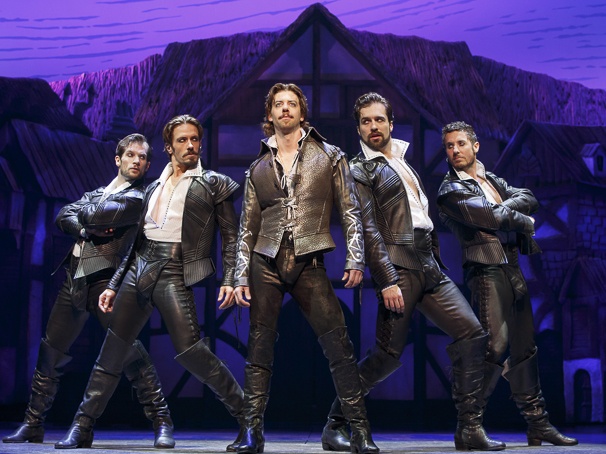
I gotta say, Something Rotten has Best Musical written all over it. Admittedly, I have yet to see most of the new musicals this season as they’re all coming out right about…now (pre-Tony time is busy, friends!). So it’s true, I might change my tune after seeing Fun Home or Finding Neverland or It Shoulda Been You. Lots of new musical potential this year (update since I wrote those last two sentences: It Shoulda and Neverland did not do too well with the critics).
But Something Rotten knows what it’s doing, and it’s got Casey Nicholaw at the helm (you can view highlights here). Now Casey and I don’t always see eye to eye. I couldn’t quite get on board with his productions of Aladdin and Elf, but then there’s the hilarious The Drowsy Chaperone and underdog The Book of Mormon. And now he’s back delivering a brand new (that’s right! NEW!), yet deliciously old-school musical full of big shtick, big comedy, and big musical numbers. And Shakespeare references!
Wait, hold up – this show is about Shakespeare? Don’t run off just yet! It’s not all uppity with super insider-y jokes (although there are plenty for the big Shakespeare fans out there). Here’s the basic premise. All the Bottom brothers, Nick (Brian D’Arcy James) and Nigel (John Cariani), want is to write a hit of their own, but they can’t get a word in edgewise because William Shakespeare (Christian Borle) is all anyone can talk about, and his new play Romeo and Juliet just premiered at the Globe. Nick will do anything to top his rival, so he goes out in search of a soothsayer (Brad Oscar) to find out what the “next big thing” might be. And what does he learn about? Why, musical theatre of course! So he dives headfirst into creating the world’s very first musical. Cut to countless hit musical references. I mean, so many you won’t catch all of them in one viewing.
Now sure, there are some easy jokes that drove me a little crazy (a woman guarantees there will be gender equality in no more than five years – get it?!), but on the whole, it’s a silly ball of fun. I don’t know the last time I laughed that hard at a musical. The score is packed with catchy tunes that you will actually leave the theatre humming. And to top it off, you have the impeccably talented cast.
Led by D’Arcy James and Borle, right off the bat, you know you’re in good hands. D’Arcy James is steadfast in everything he touches. He plays a solid straight man amidst all of the craziness but still gets his chance to cut loose. As the Bard, it’s so much fun to once again see the cockiness of Black Stache mixed with the bravado of Tony winner Borle himself. Brad Oscar is insane and hilarious, and Cariani and Kate Reinders are adorably charming and funny as the young will-they-won’t-they-couple. Oh, and Heidi Blickenstaff – I could listen to her sing all day. I wish there were more to her character, but sadly it’s not her show. This is very much about the Bottom brothers and Shakespeare, and the women unfortunately are left in the sidelines. I guess that’s what happens when a show takes place in 2015 – sorry, I mean 1595.
So. A musical chockfull of Shakespeare AND musical references? It sounds like this was made for me. How can you go wrong with a musical that’s an ode to musicals? I’m eager to see what the critics will be saying after the opening tonight, but honestly? I’m not the least bit worried about this show. Nothing’s gone rotten here.
Something Rotten! A Very New Musical
Music and Lyrics by Wayne Kirkpatrick and Karey Kirkpatrick, Book by Karey Kirkpatrick and John O’Farrell, Directed by Casey Nicholaw
St. James Theatre, Open-ended
Photo Credit: Joan Marcus
Pictured: Christian Borle and the cast of Something Rotten
Hand to God: A New American Play
Posted: April 7, 2015 Filed under: Becca Doodle - Happy, Broadway, Comedy, Play | Tags: broadway, broadwayreview, devil, handtogod, handtogodreview, newyorktheatre, possessed, possessedhandpuppet, robertaskins, sarahstiles, stevenboyer, tyrone 1 Comment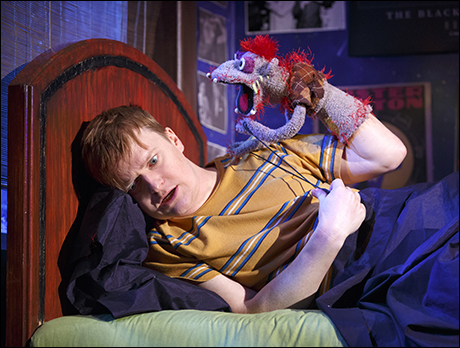
All I want to do is tell you everything about this play, but I won’t. I’m actually barely going to review it. I don’t want to spoil anything about this new show. Well, not so new; Hand to God has had a long journey to Broadway. First it ran at Ensemble Studio Theatre (EST) in 2011 and then last year Off-Broadway at MCC Theater. I remember hearing about it both times but never made the effort to see it. Now it’s made the leap to Broadway, and I encourage you to make ALL of the efforts.
I’ll tell you a few things to whet your appetite. Hand to God takes place in the small town of Cypress, Texas. A teacher there is trying to help the kids connect to Jesus and religion through puppetry. Then we meet the soft-spoken Jason, one of the students, whose hand puppet Tyrone may or may not be possessed by the Devil. Yup.
It’s a first-rate cast: Geneva Carr, Marc Kudisch, Michael Oberholtzer, Sarah Stiles, and the mind-boggling Steven Boyer as Jason (and Tyrone). I hope he wins all the Tonys. The set is spot-on; the script fresh and laugh-out-loud hilarious. It’s a cross (ha) between The Book of Mormon and Avenue Q, but it’s not a musical. A word to the easily offended: like in Mormon, there is some outrageous humor. It can be crude, sexual, and full of cursing. But man oh man, is it funny. You won’t believe some of the stuff you’re seeing and hearing. You may just blush in your seat.
This new Broadway play will make you laugh. It’ll make you think. It might make you squirm a little bit. It’ll definitely make you appreciate good theatre. Just trust me – you’ll enjoy it. Hand to God.
Hand to God
Written by Robert Askins, Directed by Moritz von Stuelpnagel
Booth Theatre, Open-ended
Photo Credit: Joan Marcus
Pictured: Steven Boyer
Side Show
Posted: December 10, 2014 Filed under: Broadway, Drama, Musical, Revival | Tags: aliceripley, broadway, broadwayreview, conjoinedtwins, daisy, daisyhilton, emilypadgett, emilyskinner, erindavie, freaks, iwillneverleaveyou, newyorktheatre, rosieodonnell, siamesetwins, sideshow, sideshowrevival, violet, violethilton, whowilllovemeasiam Leave a comment
The musical about conjoined twins brings double the thrills and double the heartbreak.
As I’ve tuned into the word of mouth and critical response this season, I’ve noticed that there are two camps of thought regarding the revival of Side Show. The buzz was nothing but positive early on, it got a great Times review, and many loved it. Meanwhile, on the other side of the spectrum, I’ve talked to people who couldn’t stand it – from the updated book to the direction of the entire piece. Whether or not this divisive response is a sign of good theatre is a conversation for another day. Instead, I’m here to tell you I’m in the first camp. I liked it! Quite a bit (watch a sneak peek here).
Side Show is based on real-life conjoined twins, Daisy and Violet Hilton, and their lives in the side show and vaudeville worlds of the 1930s. It had a brief Broadway run in 1997 starring Alice Ripley and Emily Skinner (watch them sing on Rosie O’Donnell’s old show here). The current revival is a revised version which started out at La Jolla Playhouse and then had a successful run at the Kennedy Center last summer. Now, I never saw the original, but I’m relatively familiar with the cast recording. I couldn’t sing the whole thing through from memory, but I recognize most of the tunes. All that to say, I’m not loyal to the original as I know some are. A friend of mine was very unhappy with all of the changes and found herself missing what it once was. About 60% or so has been revised: new songs, new scenes, the works.
The book is not without its flaws. The love stories get a little sloppy, but for some reason, it didn’t bother me. Things get melodramatic at times, which has never been a preference of mine, but it rides the edge nicely enough and never fully collapses into that style (like The Last Ship). A major flashback has been added to Act 1, filling in the girls’ backstory and how they ended up in a side show in Texas as the rightful property of the ringmaster. If there was one section that didn’t grab me as much as the rest, it was this scene. I understand the significance of including it, but the way it was told didn’t grab me. Harry Houdini stops by for a bit, and the action comes to a halt.
The two love interests, Terry and Buddy, who rescue the girls from the side show and make them vaudeville stars, kind of blend together. Basically, they’re underwritten. I suppose you could argue that it’s because they’re not the focus – we’re here for the twins and the twins alone. But come to think of it, the way the male romantic leads are written is similar to how many female roles are written in the canon. Not much to them, no real defining characteristics, there only to serve the purpose of the main (male) characters (Cosette, anyone?).
Flaws aside, the freaks are awesome in this. We begin with the side show and the charged opening number, “Come Look at the Freaks.” In the original, the choice was made to have everyone look “normal.” Kind of like in Violet – no make-up is used to display Violet’s terrible facial scar. It’s left up to the imagination and drives home the point of “they’re just like everyone else.” In the revival, there is nothing left to the imagination. The costumes and make-up are fantastic, and I think the message still comes through.
But let’s get to back to Daisy and Violet. Emily Padgett and Erin Davie are the heart of this musical. These two actresses are so in sync with each other that when the sisters are at odds, it’s all the more effective and challenging to watch them struggle (hear them talk about the experience of sharing a hip here). The Act One Finale, “Who Will Love Me As I Am,” is worth the price of admission in my book. Their voices together – oof, such power in their sound. Chills down my spine. The same goes for the Act 2 Finale, “I Will Never Leave You.” Both songs are show stoppers, combined with beautiful voices that lock in together perfectly.
Freak shows speaks to the inner part of us that wants to see people who look different or grotesque. I think it’s for the same reason drivers slow down on the highway to look at an accident. Ultimately, Side Show is a heart-breaking story about being different and longing for acceptance. Everyone can relate to feeling like a freak and wanting to be loved. It’s not a mistake when the spotlights on stage turn to shine on us for just a moment during the reprise of that taunting opening number. So come on, folks. Come look at the freaks.
Side Show
Book and Lyrics by Bill Russell, Music by Henry Krieger, Additional Book Material and Directed by Bill Condon
St. James Theatre, Closing January 4, 2015
Photo Credit: Joan Marcus
Pictured: Emily Padgett and Erin Davie
On the Town
Posted: November 19, 2014 Filed under: Becca Doodle - Happy, Broadway, Comedy, Musical, Revival | Tags: adolphgreen, bettycomden, broadway, broadwayreview, helluvatown, johnrando, leonardbernstein, newyorknewyork, newyorktheatre, onthetown, onthetownrevival Leave a comment
Fantastic dancing and a bright, talented cast make this one helluva revival.
For those of you out there who say you don’t know On the Town at all, I guarantee that you know at least one song. Originally produced on Broadway in 1944, it was also made into a film starring Gene Kelly and Frank Sinatra later that decade. The story doesn’t go far below the surface. It’s about three sailors trying to get laid during their 24-hour shore leave in New York City. Yup. That’s the Leonard Bernstein musical in a nutshell. But for an old-timey classic, it’s dirtier than you might expect, packed with innuendos and euphemisms.
It’s a funny thing about revivals. When a new show comes out, most of the reviews are about the content – the quality of the book and music. With something this old-school, no one is commenting on the quality of the show itself; instead it’s about the production. How the material is approached this time around. And when you’ve got John Rando at the helm (Tony winner for Urinetown), you know you’re in good hands. The production value is fantastic, the choreography stunning, plus a funky design, and an awesomely talented cast.
On the Town was the first production I was cast in at Muhlenberg; my sophomore year I played…wait for it…the Little Old Lady. She’s literally a running gag, randomly running across the stage throughout the show. The always-funny Jackie Hoffman doubles as the Old Lady and Madame Dilly (actually she pops up as other random characters, too). The focus, though, is on the six stars (the main sailors and their respective matches), and they all get a chance in the spotlight. Tony Yazbeck as Gabey is such a beautiful dancer to watch. His Tulsa really struck me in the Gypsy revival as well. Jay Armstrong Johnson’s Chip is goofy and lovable, and Clyde Alves as Ozzie never runs out of energy. Megan Fairchild plays Ivy with simple grace, and her big dance sequence with Yazbeck in the second act is wonderful. I love Elizabeth Stanley in everything, and she doesn’t disappoint as Claire de Loone. And this was my first introduction to Alysha Umphress as Hildy; that girl’s got pipes (here she is singing I Can Cook, Too).
So why see On the Town now? In the current decade? Matt and I debated this on the ride home. It’s a return to a simpler time for sure. Escapism at heart, right? Musicals today tend to make you think more (or at the very least, Sondheim intellectualized some of them). While escapism, fluff, bubblegum (whatever you want to call it) still come and go on the Broadway stage, there certainly aren’t contemporary shows with dancing like this anymore. We were trying to think of a modern musical that has full-on dance (maybe Thoroughly Modern Millie comes close?). Sure, there are dance numbers/breaks, but songs fully dedicated to dance are few and far between. You’ll typically only see that in revivals like Anything Goes, The Music Man, 42nd Street, etc. On the Town provides the eight-minute long dance sequences we’ve been missing, and this revival doesn’t flounder in that department. It features beautiful pas de deux and ensemble work (highlights here). The choreography and execution are gorgeous in this production and one of the best reasons to go see it. And it’s not just the ensemble – this is a show in which the principles have to be real dancers as well. You know it’s a legit dance show when the lead woman is New York City Ballet’s #1 ballerina.
So yes, it may be a random, at times senseless plot (with some objectifying of both genders thrown into the mix for good measure), but for a great Greene/Comden/Bernstein throwback, classic show tunes, and beautiful dancing, I say it’s worth a trip to go get Carried Away.
On the Town
Music and Lyrics by Leonard Bernstein, Book and Lyrics by Betty Comden and Adolph Green, Directed by John Rando
Lyric Theatre, Open-ended
Photo Credit: Joan Marcus
Pictured: The Cast of On the Town
It’s Only a Play
Posted: November 12, 2014 Filed under: Becca Doodle - Sad, Broadway, Comedy, Play, Revival | Tags: broadway, ferrisbueller, harrypotter, itsonlyaplay, matthewbroderick, mcnally, meganmullally, nathanlane, newyorkreview, newyorktheatre, review, ronweasley, rupertgrint, stockardchanning, terrencemcnally, thenance, theoddcouple, theproducers Leave a comment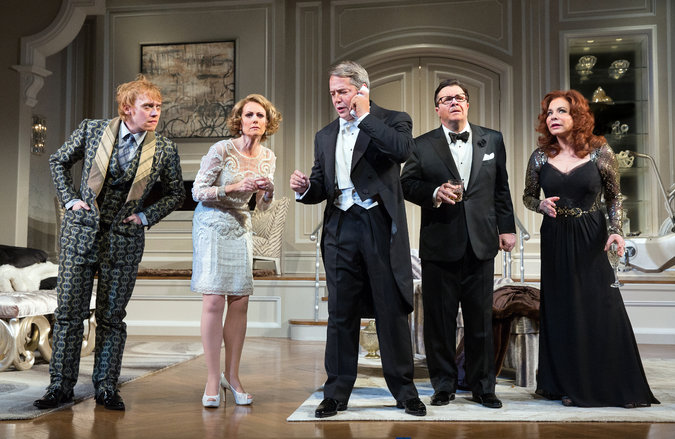
This Terrence McNally revival packs a lot of star power but no punch.
Listen folks, I’m sorry to report that I was disappointed by It’s Only a Play. Matt and I were very much looking forward to it, and being that it’s one of the hottest tickets, this was one of our splurges money-wise this season. With its starry cast, stellar creative team, and modernized script, we figured we couldn’t go wrong.
The loose plot centers around a group of theatre people at an opening night party awaiting the reviews, primarily the Times. You’ve got the producer (Megan Mullally), the playwright (Matthew Broderick), the director (Rupert Grint), the star (Stockard Channing), a critic (F. Murray Abraham), the playwright’s friend who passed on the project (Nathan Lane), and the coat check boy (“introducing Micah Stock”). All in one room told in real time (click here for highlights).
Things start out amusingly enough. I mean, I’ll watch Nathan Lane live anytime with a perfectly content smile on my face. There’s a section early on with just him on stage, and I would have been happy if the whole play had been that. Maybe I’ll go watch The Nance on PBS instead and revisit that production.
It’s Only a Play is overflowing with inside jokes about the theatre world, many of which would completely go over the average theatre-goer’s head. McNally has updated all of the now-dated references to today’s celebrities and to more recent theatre tiffs (e.g. Shia LaBeouf, Alec Baldwin). Practically every show currently running on Broadway is thrown into the mix, and it gets old fast. There is more name-dropping in this show than…um…just trust me. Hilary Clinton, Denzel Washington, Frank Langella, Lady Gaga, a whole lotta names – most of which are mentioned alongside jokes at their expense. There are so many punchlines that are equivalent to a celebrity shout-out that it started to get on my nerves. Those are cheap shots in my book (although the malicious jokes didn’t seem as malicious coming out of Lane’s mouth).
Matthew Broderick’s stiff performance falls flat with his consistently understated and monotone delivery. Any energy that is built up by the other characters collapses around them when he arrives onstage. He has a huge speech in the first act (which ends with the line: “Speech done”) when he gets up on a soap box and talks about the theatre today and how its integrity is basically falling apart at the seams. What have we done to it? Remember the good old days? And so on and so forth. People applauded like crazy afterward, yet I sat there feeling insulted. I understand the self-awareness aspect of referencing the trend of movie stars taking over Broadway and names above the title, and that’s what this play is doing too (get it??), but it didn’t come across as witty to me. [title of show] did the self-aware comedy much more effectively and humorously. Nathan Lane’s character referring to the actor Nathan Lane for an easy laugh? Come on. There was so much applause after lines, big speeches, entrances, and exits, I couldn’t wrap my head around it. Were the people around us clapping for the play? The production? Or just the stars they love? Does Stockard Channing leaving the stage after saying something triumphantly warrant exit applause? If it had been any other actor, would the audience have cared?
Wow, I’m starting to sound bitter. Let me dial it back, and get back on topic. Take a breath, Becca.
Perhaps I’m not the target audience. I know that the most of the reviews tell me I’m in the minority, but neither Matt nor I laughed much. Grint was a caricature, as was Mullally. This approach could maybe work if everyone was giving the same stylized performance, but with Broderick, for example, playing everything down, you’re left with a bunch of people in different plays. One of the things that makes You Can’t Take It With You such a hit in my book is that it has a cast of fully-realized individual characters who all could be the star of the show with their crazy antics, but simultaneously, they’re in sync with one another. That family is under the same roof and in the same play, whereas It’s Only a Play’s characters all seem to be attending different opening night parties.
It’s Only a Play
Written by Terrence McNally, Directed by Jack O’Brien
Schoenfeld Theatre, Closing January 4, 2015
Photo Credit: Sara Krulwich
Pictured: Rupert Grint, Megan Mullally, Matthew Broderick, Nathan Lane and Stockard Channing

 Becca on Broadway